Ministry of Environment, Forest and Climate Change
MoEFCC Secretary addresses Valedictory Session of TERI’s World Sustainable Development Summit 2026
India Refuses to Solve Yesterday’s Poverty by Creating Tomorrow’s Ecological Crisis, says Shri Tanmay Kumar
Posted On:
27 FEB 2026 7:52PM by PIB Delhi
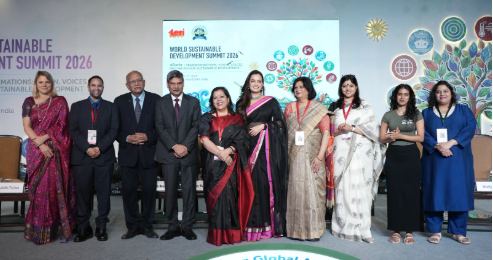
Secretary, Union Ministry of Environment, Forest and Climate Change, Shri Tanmay Kumar, today delivered the valedictory address at the Silver Jubilee edition of TERI’s World Sustainable Development Summit (WSDS) 2026, in New Delhi. The dignitaries on the dias included Ms. Dia Mirza, Goodwill Ambassador, United Nations Environment Programme; Ms. Isabelle Tschan, Deputy Resident Representative, United Nations Development Programme; Shri Nitin Desai, Chairman, TERI and Dr. Vibha Dhawan, Director General, TERI, among others.
Addressing the august gathering, Shri Kumar said India is pursuing a model of development that integrates growth, poverty eradication, urbanisation, industrialisation and decarbonisation simultaneously, unlike the historical high-emission pathways adopted by the developed world. He said climate change is no longer confined to environmental debate but has become a defining challenge of development, governance, security and human welfare.
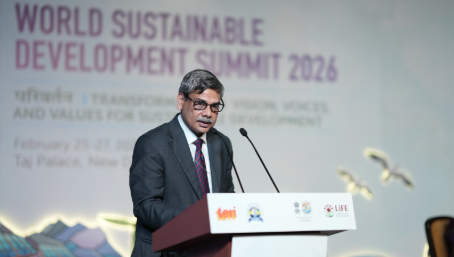
The Secretary noted that the first Global Stocktake of the Paris Agreement calls for a 43 per cent reduction in global emissions by 2030. However, he said, global trajectories reveal a significant gap, particularly due to inaction by the developed world. Shri Kumar pointed out that between 1850 and 2019, developed countries contributed nearly half of global CO₂ emissions, while India’s historical contribution remains negligible.
India, the Secretary highlighted, houses 17 per cent of the world’s population but its per capita emissions are about two tonnes per year, which is significantly below the global average. While developed countries industrialised through coal-based growth, oil-powered mobility and deforestation, he said India is industrialising cleaner from the start.
Looking ahead to ‘Viksit Bharat’ by 2047, when India marks 100 years of independence, Shri Kumar said the vision is for a developed India that is not a carbon copy of the past. This includes transit-oriented cities, efficient industries powered increasingly by green energy, a power grid integrating large renewables and storage, and a circular economy that reduces material intensity.
Emphasising equity and intergenerational justice, Shri Kumar said India refuses to solve yesterday’s poverty by creating tomorrow’s ecological crisis, and will continue to pursue a development model that safeguards dignity, inclusivity, productivity and sustainability for future generations.
Highlighting India’s measurable environmental gains, Shri Kumar said that as per the latest FAO report, India ranks ninth globally in forest area and third in annual net forest gain. He described this as a testament to sustained conservation efforts alongside development. He also noted the rapid expansion of wetland conservation, with 11 new Ramsar sites added in 2025, taking the total to 98, is the highest in Asia.
The Secretary underlined key reforms undertaken by the Ministry in recent years, including the Green Credit Programme, Van Sanrakshan Evam Samvardhan Rules, 2025; Environment Protection (Management of Contaminated Sites) Rules, 2025; Environment Audit Rules, 2025, and PARIVESH 2.0. These initiatives, he said, reflect India’s commitment to transparent, efficient and forward-looking environmental governance while supporting sustainable economic activity and inclusive growth.
On climate commitments, Shri Kumar said India is on track to achieve a 45 per cent reduction in emission intensity of GDP by 2030. The revised target of 50 per cent cumulative electric power capacity from non-fossil fuel sources was achieved in June 2025, ahead of schedule. India is also in the process of revising its Nationally Determined Contributions (NDCs), he added.
Concluding his address, the Secretary noted that while the developed world followed a “coal-first industrialisation” model, with high per capita emissions and net forest loss, India’s pathway is based on low per capita emissions, clean energy expansion at scale through solar and wind, increasing forest and tree cover, and a lifestyle-based approach through Mission LiFE.
On the sidelines of TERI’s WSDS, MoEFCC organized Him-CONNECT, a dedicated platform to connect researchers working in the Himalayan region with start-ups, industry leaders, investors and policymakers. The Summit also marked the release of the Act4Earth Manifesto, reinforcing collective commitments towards accelerated climate action emanating from the Summit.
*****
VM/GS
(Release ID: 2233672)
Visitor Counter : 152