Ministry of Panchayati Raj
Union Minister Shri Rajiv Ranjan Singh Urges Concerted Efforts to Build ‘Atmanirbhar Panchayats’ at National Workshop on People’s Plan Campaign, in New Delhi
PPC 2026–27 Booklet Released; MoU Signed to Set Up EV Charging and Battery Swapping Stations on Panchayat Land across the country
Posted On:
31 OCT 2026 11:33AM by PIB Delhi
Union Minister of Panchayati Raj and Fisheries, Animal Husbandry and Dairying, Shri Rajiv Ranjan Singh alias Lalan Singh called for the participation of all stakeholders in the efforts being made towards achieving ‘Atmanirbhar Panchayats’ (self-reliant Panchayats) and ‘Viksit Panchayats’ (developed Panchayats). He was addressing the National Workshop on the People’s Plan Campaign (PPC) 2026-27, organised by the Ministry of Panchayati Raj in New Delhi on 30th October 2026, that saw participation of over 400 participants from across the country. During the workshop, PPC 2026–27 booklet (English/Hindi) was also released. Additionally, the Ministry also signed a Memorandum of Understanding (MoU) with Convergence Energy Services Limited (CESL), a wholly owned subsidiary of Energy Efficiency Services Limited (EESL) under the Ministry of Power, for establishing Electric Vehicle (EV) charging and battery swapping stations on Panchayat land throughout the country.
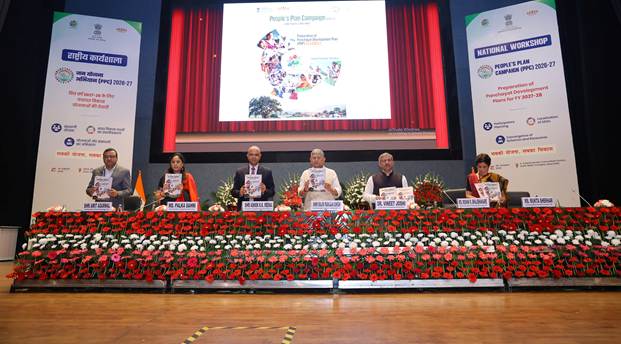
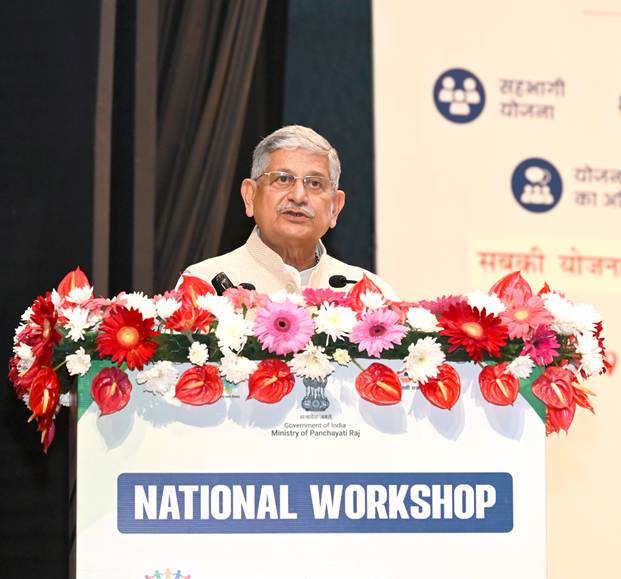
Shri Rajiv Ranjan Singh informed the gathering about the landmark decision of the Union Cabinet approving the Pradhan Mantri Viksit Gram Swaraj Yojana (PM VGSY), a next-generation governance transformation initiative aligned with the national vision of Viksit Bharat. Outlining the key objectives of PM VGSY, the Union Minister highlighted the need to create awareness about government schemes, promote discussions and deliberations at the grassroots level, integrate Centre and State schemes across departments through a common digital platform, ensure timely preparation of Gram Panchayat Development Plans (GPDPs) and build the capacities of Panchayat representatives and stakeholders for effective grassroots governance. He said that the approval of PM VGSY reflects the Government’s abiding faith in Panchayats as the foundation of democracy and recognises that the vision of Viksit Bharat can be realised only through Viksit Panchayats. Panchayats, he observed, become truly Atmanirbhar when Gram Sabhas plan with confidence, Own Source Revenue (OSR) is steadily augmented and every level of government works in convergence. Underlining that Gram Panchayats need to enhance their own-source revenue generation to become eligible for performance grants, he urged them to work towards the Sankalp of ‘Atmanirbhar Panchayat’ for achieving the goal of Viksit Bharat 2047. The Union Minister urged all stakeholders to work together to strengthen Panchayats and enable them to explore sustainable sources of revenue, ensuring that local development is driven by local priorities. Highlighting that the People’s Plan Campaign (PPC) 2026–27, launched on 2 October 2026, has placed citizens at the centre of the planning process, he emphasised the importance of participatory planning, digital platforms and Jan Bhagidari, as envisioned by Hon’ble Prime Minister Shri Narendra Modi.
Dr. Vineet Joshi, Secretary, Ministry of Panchayati Raj, in his keynote address, said that the Cabinet’s decision on PM VGSY provides a strong foundation for decentralised, evidence-based planning. He highlighted that the PPC, run by the Ministry since 2018 under the theme “Sabki Yojana, Sabka Vikas”, has evolved into a robust framework for the preparation of Gram, Block and District Panchayat Development Plans, the localisation of the Sustainable Development Goals, and the convergence of schemes and resources. Emphasizing upon structured, participatory and inclusive planning, he noted that the Sixteenth Finance Commission, for the award period 2026-31, has recommended total grants amounting to Rs.4,35,236 Crore for duly constituted Panchayati Raj Institutions/ Rural Local Bodies in all 28 States, placing greater responsibility on Gram Panchayats to ensure optimal utilization of funds. Dr. Joshi stressed that GPDPs should be comprehensive development plans based on people’s needs and aspirations, rather than being limited to available schemes or funding sources, and underlined the need for an OSR component in GPDPs, as performance-based grants are linked to revenue generation by Panchayats. He called for technology-enabled integration/ convergence of the portals of the Centre and the States, including eGramSwaraj and the Samarth Panchayat Portal, so that integrated data supports better outcome-based planning at the grassroots. Dr. Joshi said that PM VGSY will ensure holistic planning at the Gram Panchayat level, and emphasized upon the need for active participation in Gram Sabhas, use of local data, inter-departmental convergence, improved quality of GPDPs for FY 2027-28, and experience-sharing among the States.
Shri Ashok K. K. Meena, Secretary, Department of Drinking Water and Sanitation, said that Panchayats have a central role in ensuring sustained delivery of drinking water and sanitation services, which is directly linked to health and dignity. He highlighted the significant role of Gram Panchayats in water and waste management, and stressed their training and capacity building through PM VGSY. He said that GPDPs should adequately address issues of water and sanitation including water sources, quality, maintenance, availability of trained manpower along with garbage management, and underlined the effective utilisation of tied grants under the Sixteenth Finance Commission, with Jal Seva and Swachh Seva Aankalan used to identify gaps and incorporate the findings into GPDPs. Emphasizing upon the broader vision of augmenting the OSR of Panchayats, Shri Meena highlighted the importance of user charges for sustaining water and sanitation services, so that Panchayats progress towards financial self-reliance. He called for greater accountability of Gram Panchayats through Gram Sabhas, with data used to support better planning, investment and informed decision-making.
Smt. Palka Sahni, Joint Secretary, Ministry of Panchayati Raj, highlighted the progress made through thematic Panchayat Development Plans and the need to further strengthen their quality, comprehensiveness and responsiveness to local development priorities. Ms. Rohini R. Bhajibhakare, Joint Secretary, Ministry of Rural Development emphasised the need for comprehensive and convergent Gram Panchayat Development Plans to ensure holistic rural development. The Workshop will be followed by State-, District- and Block-level orientations to guide Panchayats in preparing quality, participatory and convergent Development Plans for FY 2027–28.
MoU to Establish Vehicle (EV) Charging and Battery Swapping Stations on Panchayat land
In a significant step towards strengthening the financial sustainability of Panchayats and advancing India’s clean energy agenda, the Ministry of Panchayati Raj signed a Memorandum of Understanding (MoU) with Convergence Energy Services Limited (CESL), a wholly owned subsidiary of Energy Efficiency Services Limited (EESL) under the Ministry of Power, for establishing Electric Vehicle (EV) charging and battery swapping stations on Panchayat land. The MoU was signed in the presence of Shri Rajiv Ranjan Singh alias Lalan Singh, Union Minister of Panchayati Raj, and Shri (Dr.) Vineet Joshi, Secretary, Ministry of Panchayati Raj and was exchanged by Smt. Mukta Shekhar, Joint Secretary, MoPR and Shri Akhilesh Kumar Dixit, Director, CESL. It marks an innovative convergence of rural local governance, green mobility and sustainable revenue generation. The partnership will create new Own Sources of Revenue (OSR) opportunities for Gram, Block and District Panchayats across States and Union Territories, and take clean mobility infrastructure beyond urban centres, including suitable locations along State and National Highways and Panchayat premises, for two-wheelers, three-wheelers, four-wheelers, and medium and heavy-duty vehicles. The Ministry will facilitate coordination with State Panchayati Raj Departments for identification and monitoring of suitable sites, while CESL will undertake site assessment, demand aggregation, supply, installation, testing, commissioning, operation and maintenance.
The initiative is aligned with the Ministry’s efforts to empower Panchayats through enhanced OSR generation, including the recently released Model Panchayat Tax, Rates and Fees Rules (Model OSR Rules), which provide a framework for transparent, accountable and locally driven revenue mobilisation. Panchayat land will become a productive community asset, generating recurring income for civic services, infrastructure and community welfare, while improving access to EV services and reducing carbon emissions in rural areas. Through this collaboration, MoPR and CESL will explore how Panchayat-level public assets can help expand access to electric-mobility infrastructure while contributing to the broader objectives of clean and green villages, sustainable local development and financially stronger Panchayats.
***
AA
(Release ID: 2330751)
Visitor Counter : 194