Ministry of Housing & Urban Affairs
Swachh Survekshan Awards 2025-26
President of India Smt. Droupadi Murmu Awards the Nation’s Cleanest Cities after the Swachh Survekshan 2025–26
AHMEDABAD (Mentor) – SANAND (Mentee), INDORE (Mentor) - DEPALPUR (Mentee) & TIRUPATI (Mentor) - KUPPAM (Mentee) rank top 3 in ‘Swachh Shehar Jodi category for accelerating urban waste management excellence
NAVI MUMBAI, SURAT & VIJAYAWADA Declared Top 3 in Clean Cities of Super Swachh League
GVMC VISAKHAPATNAM, JABALPUR and LUCKNOW Emerge as India’s top 3 Swachh Shehar in the Million Plus population category
This year awards were given for the first time to Swachh River Front Town, Swachh Coastal Town and Clean Himalayan City,
350+ ULBs jump 500 ranks to move up in Swachh Survekshan 2025-26
Smaller Cities Lead the Change: 1,700+ ULBs with population under 50k Improve Their Rankings Over 2024–25
State-Level Winners to Be Honoured in Award Ceremonies in respective States
Posted On:
11 NOV 2026 8:31PM by PIB Delhi
Smt. Droupadi Murmu, Hon’ble President of India, honoured India’s cleanest cities at the Swachh Survekshan Awards 2025–26 held at Vigyan Bhawan, New Delhi, convened by the Department of Urban Development (DoUD), Ministry of Housing and Urban Affairs (MoHUA). Winners were felicitated in the presence of Sh. Manohar Lal, Union Minister for MoHUA & Power and Shri Tokhan Sahu, Minister of State for MoHUA. This year 60 national awards have been announced, under 5 categories:
- Swachh Shehar Jodi (SSJ)
- Clean Cities of Super Swachh League
- Swachh Shehar in 5 population categories
- Swachh River Front Town
- Swachh Coastal Town
- Clean Himalayan City
- State First Swachh City
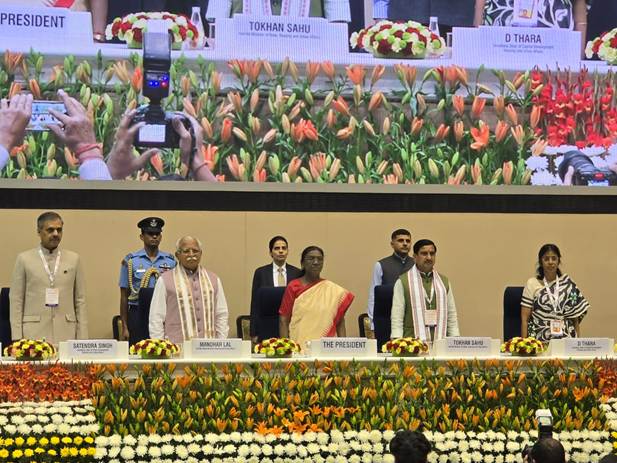
Speaking at the event, Smt. Droupadi Murmu, Hon’ble President of India, underscored that cleanliness cannot be achieved through the efforts of any single institution alone and requires active participation from all stakeholders. She emphasized the importance of citizen participation, behavioural change, administrative accountability, and sustained public engagement. Highlighting the need to inculcate cleanliness values from an early age, she called for integrating issues such as plastic waste management into school curricula and fostering continuous dialogue with children and youth. The President noted that meaningful progress in sanitation is possible when citizens, local administrations, and sanitation workers work together, and when the on-ground suggestions of sanitation workers and citizen feedback are given due importance. She also appreciated the Swachh Shehar Jodi initiative as a new dimension of collaborative learning, enabling cities to share innovations, test solutions, and support one another in achieving higher standards of urban cleanliness.
Addressing the gathering, Union Minister for Housing and Urban Affairs Shri Manohar Lal said that under the visionary leadership of Prime Minister Shri Narendra Modi, the Swachh Bharat Mission has evolved into a nationwide people's movement, transforming urban sanitation and encouraging greater citizen participation. Highlighting the progress achieved since 2014, he stated that urban waste processing has increased from 16% to 80%, while door-to-door waste collection coverage has risen from 44% to over 96%. He further noted that the remediation of legacy waste dumpsites has freed nearly 11,000 acres of urban land for productive use.
The Hon’ble Minister also encouraged States to conduct Swachh Survekshan competitions at the State level to rank cities and towns within their respective States, fostering healthy competition among Urban Local Bodies (ULBs) and encouraging smaller towns to improve their cleanliness standards.
Shri Manohar Lal highlighted the growing scale and impact of Swachh Survekshan, which has expanded from 73 cities in 2016 to 4,751 cities in 2025–26. He informed that 2.70 crore citizens provided feedback during this year's survey, while over 1,700 smaller cities improved their rankings and more than 350 cities registered improvements of over 500 positions. Emphasising the importance of behavioural change, the Minister said that the real success of Swachh Survekshan lies not merely in improving rankings but in making cleanliness a permanent habit and collective responsibility. He also highlighted the participation of nearly 2.10 crore citizens in Swachhata Hi Seva 2026, the benefits extended to around 17 lakh SafaiMitras through over 33,000 special camps, and the participation of nearly 4 lakh children in Gyan Yatras.
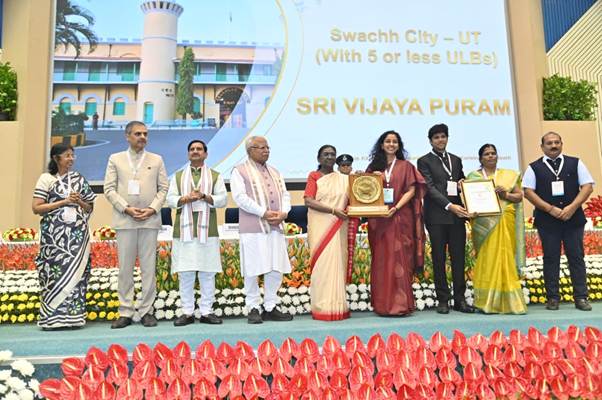
The Minister further highlighted several new initiatives aimed at strengthening collaboration and encouraging excellence in urban sanitation. He stated that under the Swachh Shehar Jodi initiative, 70 mentor cities have been paired with 191 mentee cities to facilitate knowledge-sharing and improve sanitation outcomes. He also referred to the introduction of special award categories for River Front Towns, Coastal Towns and Himalayan Cities, along with recognition across five population categories to ensure wider participation. Highlighting the PRAGATI-50 initiative, Shri Manohar Lal said that 50 cities would be developed as Model Clean Cities through technology-driven interventions and continuous monitoring. Congratulating all award-winning cities, urban local bodies and SafaiMitras, he reiterated the Government's commitment to making cleanliness an integral part of urban life and realising the vision of a Swachh and Viksit Bharat.
Sh. Satendra Singh, Secretary, DoUD, MoHUA, highlighted how Swachh Survekshan has, over the past decade, strengthened the assessment and improvement of urban sanitation services while driving tangible on-ground outcomes under the Mission. Secretary, MoHUA, further mentioned that Swachh Survekshan is much more than an assessment; it is the collective voice of millions of people committed to the vision of a Swachh Bharat. He said, “today is a celebration of the outstanding efforts made by our cities and citizens in advancing the cause of cleanliness.”
The Swachh Survekshan 2025–26 results reflect a strong upward momentum across urban India, with over 350 ULBs improving their position by more than 500 ranks. Smaller cities have emerged as key drivers of this transformation, as 1,700+ ULBs with populations below 50,000 population improved their rankings compared to 2024–25, demonstrating that sustained efforts and citizen participation are accelerating the Swachhata movement across towns of all sizes.
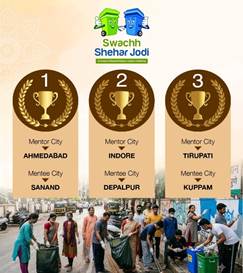
Showing excellence in collaborative efforts and peer-learning, Mentor city Ahmedabad & Mentee city Sanand, Mentor Indore & Mentee Depalpur and Mentor Tirupati & Mentee Kuppam, were declared the top-ranked jodis under Swachh Shehar Jodi award. The Top 3 Swachh Shehar Jodis have been identified based on the combined score of the Mentor City (SS 2024-25 awardee) and its paired Mentee City. It reflects the joint performance and collaborative efforts of both cities under the Swachh Shehar Jodi initiative, thereby recognizing mentorship outcomes along with overall cleanliness and service delivery improvements. The intention of Jodi award is that the best performing cities should handhold cities with low scores to improve their performance. The initiative started after 2024-25 award ceremony with the motive of Each One - Teach One and rooted in India’s timeless Guru–Shishya tradition, where knowledge, experience, and best practices are passed on from one city to another to collectively advance the journey towards urban excellence and cleanliness.
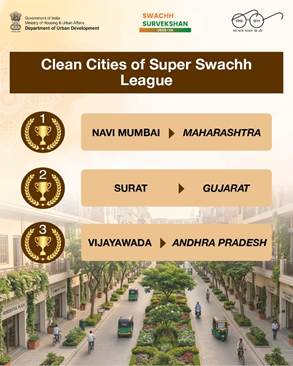
Maharashtra’s Navi Mumbai, Gujarat’s Surat and Andhra Pradesh’s Vijayawada emerged as top 3 Clean Cities of Super Swachh League.
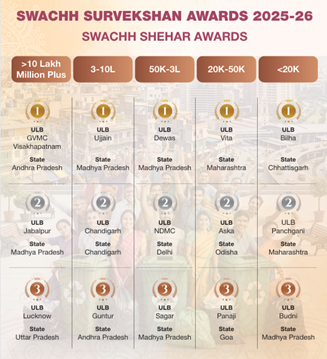
Marking the rise of a new generation of clean cities, GVMC Visakhapatnam, Jabalpur and Lucknow emerged as India’s top Swachh Shehar in the million plus population category.
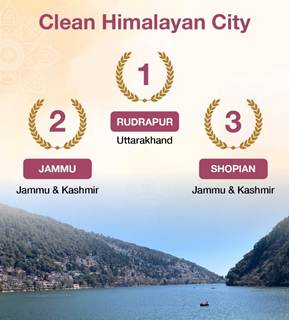
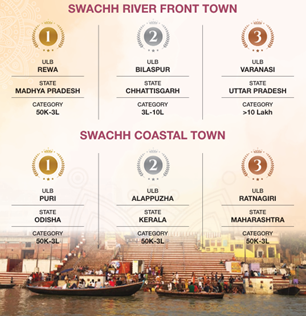
Swachh Survekshan Awards 2025-26 expanded its coverage to include the Hills and Himalayan cities as well as River front and coastal towns. Rudrapur in Uttarakhand, Jammu & Shopian in J&K have been declared as the top 3 Clean Himalayan Cities. Riverfronts, coastlines and water bodies, are an integral part of the natural and cultural heritage. Their cleanliness is essential not only for environmental sustainability but also for the health and livelihoods of communities. In line with the same, the top 3 ranks for the Swachh River Front Town have been bestowed upon Rewa (MP), Bilaspur (Chhattisgarh) & Varanasi (UP) consecutively, while awards for Swachh Coastal Town went to Odisha’s Puri, Kerala’s Alappuzha and Maharashtra’s Ratnagiri.
To recognize and reward excellence across States and Union Territories, the State First Swachh City Award was conferred on 30 top-performing cities. Union Territories have been classified into two categories for awards: (i) Up to 5 ULBs and (ii) more than 5 ULBs.
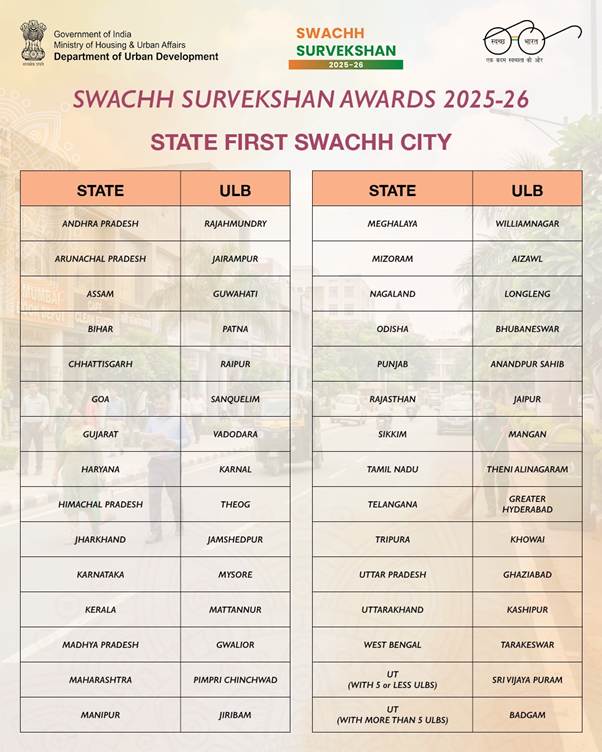
As part of the 10th edition of Swachh Survekshan, Urban Local Bodies (ULBs) were assessed across 43 indicators covering 10 critical domains, including Segregation, Collection & Transportation of Waste, Solid Waste Management, Visible Cleanliness, Access to Sanitation, Mechanisation of Desludging Services, Ecosystem Strengthening & Institutional Parameters, Used Water Management, Advocacy for Swachhata, Overall Welfare of Sanitation Workers, Citizen Feedback & Grievance Redressal. Over 3,000 trained assessors undertook extensive on-ground evaluations nationwide, supported by real-time GPS-enabled monitoring. From evidence submission to verification, the entire assessment process was conducted through a fully digital, transparent, and rigorously quality-assured framework, ensuring credibility and consistency at every stage.
*****
SK
(Release ID: 2335207)
Visitor Counter : 1914