PIB Backgrounder
The Manufacturing Transformation Powered by PLI
From Policy to Production
Posted On:
13 NOV 2026 5:36PM by PIB Delhi
Production Linked Incentive (PLI) framework has emerged as one of India's most significant industrial policy interventions. Spanning 14 strategic sectors, the scheme has attracted investments, expanded manufacturing capacity, boosted exports and generated employment across the country. More importantly, it has helped strengthen domestic value chains and position India as a competitive manufacturing destination. As India advances towards Viksit Bharat 2047, PLI is laying the foundations for a more resilient, innovative and globally integrated industrial economy.
|
The Moment India Decided to Build
A smartphone assembled in Tamil Nadu. A solar module manufactured in Gujarat. A pharmaceutical ingredient produced in a bulk drug park. These are not isolated milestones. They are proof points of India's emergence as a more self-reliant, technology-driven and globally integrated economy. In sectors such as electronics, electric mobility and renewable energy, the focus is shifting from building capacity to building ecosystems.
At the heart of this shift lies the Production Linked Incentive (PLI) Scheme, introduced in 2020. Over the past six years, it has catalysed investments across sectors - translating policy ambition into production capacity. As India advances towards Viksit Bharat 2047, the next phase depends on deepening value chains and strengthening India's role in global production networks.
From Policy to Production: The Rise of the PLI Framework
Launched under Atmanirbhar Bharat, the PLI scheme was designed to accelerate manufacturing growth.
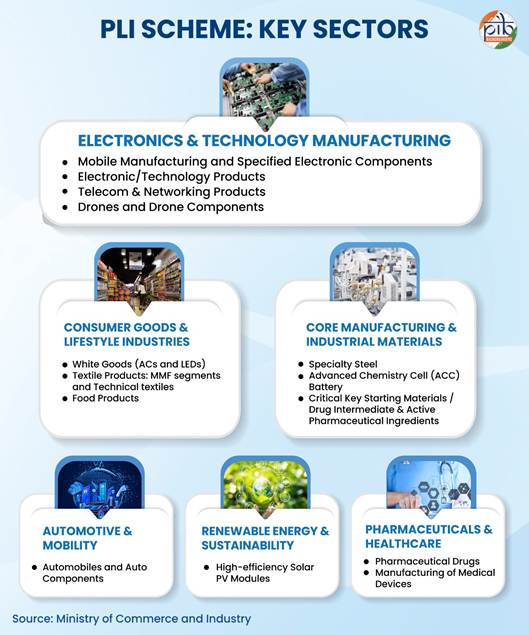
Initially, it encompassed sectors such as mobile manufacturing, specific electronic components, active pharmaceutical ingredients, and medical devices. However, as the scheme evolved, it expanded to encompass a total of 14 strategic sectors, including pharmaceuticals, textiles, specialty steel, etc., with a total approved financial outlay of ₹1.91 lakh crore (₹1,91,049 crore). At its core lies a simple idea- when domestic industries grow in scale, quality and competitiveness, investment, exports, jobs and innovation grow alongside them.
The Numbers Behind the Transformation
India’s manufacturing and export performance is gaining momentum across several PLI-supported sectors. During 2021- 2025, several PLI sectors recorded strong export growth, including IT Hardware (77.2%), ACC Batteries (45.0%), Electronics (38.8%), Solar PV Modules (23.9%), and Specialty Steel (22.5%) on an average annual basis.
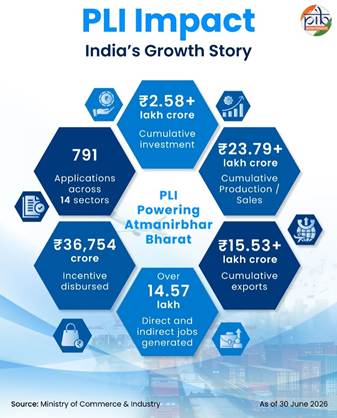
As of 30 June 2026, approved applications stood at 791 across 14 sectors, with cumulative actual investment exceeding ₹2.58 lakh crore (₹2,58,835 crore) and cumulative production/sales crossing ₹23.79 lakh crore. Exports were boosted by ₹15.53 lakh crore, while over 14.57 lakh direct and indirect jobs were generated (comprising 8.81 lakh direct jobs and 5.75 lakh indirect jobs across IT Hardware, LSEM, and Solar PV Modules). Cumulative incentive disbursement reached ₹36,754 crore. The level of incentive disbursement reflects the performance-linked nature of the scheme. Incentives are released when companies meet the required investment, production and other eligibility criteria. As projects move forward and begin production, eligible claims are made in line with the provisions of the respective schemes.
Sectoral outcomes show deeper localisation, with mobile imports declining nearly 77%.
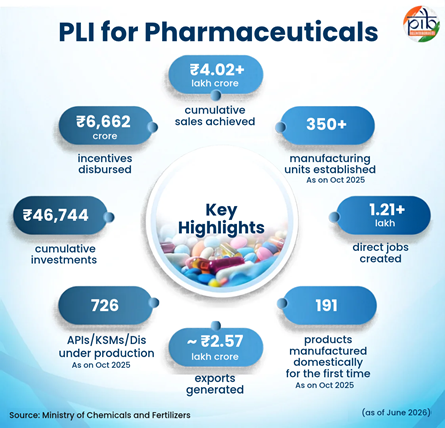
PLI also enabled first-time domestic manufacturing of 191 bulk drugs, while telecom exports reached ₹21,033 crore.
These trends reflect how domestic manufacturing is increasingly integrating with global value chains.
Building the New Industrial India
Across sectors, the PLI framework is translating policy into tangible outcomes. New factories, expanded production lines and emerging industrial clusters are reshaping India's manufacturing landscape. Policy support is translating into tangible outcomes, creating new opportunities for industry, workers and entrepreneurs alike. Some of the sectors with clear outcomes are:
Large Scale Electronics Manufacturing (LSEM): Powering India's Digital Manufacturing Rise
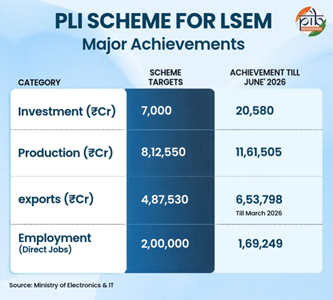
The electronics manufacturing and IT hardware sector has been the largest beneficiary of the PLI scheme. With the LSEM scheme tenure now completed, companies under the scheme achieved a cumulative investment of ₹20,580.20 crore (nearly three times the initial target of ₹7,000 crore), cumulative production of ₹11,61,505 crore, direct employment of 1,69,249, and cumulative incentive disbursement of ₹19,090.98 crore till June 2026 (alongside ₹954 crore investment, ₹24,386 crore production, 5,216 direct jobs, and ₹97.84 crore disbursed under IT Hardware 2.0). Electronics production rose from ₹11.32 lakh crore in 2024-25 to ₹13.11 lakh crore in 2025-26, a 15.8% year-on-year increase.
This growth reflects a significant shift in India’s electronics manufacturing capabilities. Compared with 2014-15, electronics production is now seven times higher. Electronics exports have increased eleven-fold to ₹4.24 lakh crore, strengthening India’s global market presence. Mobile manufacturing has emerged as a key driver of this transformation. Mobile phone production has risen 33 times to ₹6.27 lakh crore. India today is the second largest mobile manufacturer in volume terms. The country has transitioned from being a net importer of mobile phones in 2014 to becoming a net exporter of mobile phones. Further, 99.2% of mobile phones used in India are now made domestically.
Pharmaceuticals: Strengthening the Pharmacy of the World
India is the world's 3rd largest pharmaceutical industry by volume and 11th largest by value. The country supplies nearly 20% of the world’s generic medicines and serves a significant share of pharmaceutical demand across key markets.
PLI Scheme for Pharmaceuticals has a financial outlay of ₹15,000 crore for 2020- 21 to 2028- 29. The scheme supports domestic manufacturing of high-value pharmaceutical products and technological upgradation.
Reflecting strong industry confidence, as on 30 June 2026, the scheme has recorded cumulative investments of ₹46,744 crore, cumulative production/sales of ₹4,02,869 crore (over ₹4.02 lakh crore), direct employment of 1,21,294, and cumulative incentive disbursement of ₹6,662 crore, supporting investments in advanced manufacturing, product diversification, and export-oriented growth. Additionally, under the Bulk Drugs PLI scheme (outlay of ₹6,940 crore), cumulative investment reached ₹5,211 crore, sales ₹3,792 crore, direct jobs 5,127, and incentives ₹88 crore; while under the Medical Devices PLI scheme (outlay of ₹3,420 crore), investment reached ₹1,185 crore, sales ₹16,612 crore, direct jobs 5,769, and incentives ₹266.64 crore.
Telecom & Networking Products: Advancing Import Substitution
The telecom sector emerged as one of the early success stories under the PLI framework with a financial outlay of ₹12,195 crore. During 2021-25, telecom exports recorded an average annual growth of 1.5 per cent, while imports declined by 18.5 per cent annually. As of 30 June 2026, the scheme has attracted cumulative investments of ₹5,627 crore, achieved cumulative production/sales of ₹1,20,721 crore, created 36,319 direct jobs, and disbursed ₹2,796 crore in incentives. This trend indicates an early accomplishment in import substitution, aligning with the PLI framework's overarching objective of enhancing market penetration abroad.
White Goods (ACs and LED Lights): Building the Parts That Matter
Behind every air conditioner and LED light lies a network of high-value components that determine both cost and competitiveness. Through the PLI Scheme for White Goods (with a financial outlay of ₹6,238 crore), India is steadily building these capabilities at home. Reflecting the sector's growing momentum, budgetary support increased from ₹303.54 crore in 2025-26 (Revised Estimate) to ₹1,003.54 crore in 2026-27 (Budget Estimate). The fourth round of the scheme attracted 13 applications with committed investments of ₹1,914 crore. The applications were received during the window from 15 September to 10 November 2025, with strong participation from MSMEs. As of 30 June 2026, the scheme has achieved cumulative investments of ₹7,670 crore, cumulative production/sales of ₹57,057 crore, direct employment of 54,049, and cumulative incentive disbursement of ₹593 crore.
Automobile & Auto Components Industry: Driving the Mobility Revolution
The PLI Scheme for Automobiles and Auto Components is accelerating India’s transition towards advanced and sustainable mobility. With an outlay of ₹25,938 crore, the scheme is supporting development of electric vehicles, advanced automotive technologies and high-value components, while strengthening India’s position in the global automotive value chain.
The government’s continued commitment is reflected in the increase in budgetary support, from ₹2,091.26 crore in 2025-26 (RE) to ₹5,939.87 crore in 2026-27 (BE). As of 30 June 2026, the scheme has attracted cumulative investments of ₹45,477 crore, recorded cumulative production/sales of ₹64,374 crore, generated direct employment of 71,337, and disbursed ₹3,174.15 crore in incentives.
Food Processing Industry: From Farm Gates to Global Markets
The food processing sector is combining manufacturing growth with rural value creation. With an outlay of ₹10,900 crore, PLI Scheme for the Food Processing Industry (PLISFPI) is being implemented from 2021-22 to 2026-27. As of 30 June 2026, around 3.36 lakh (3,35,516) direct and indirect jobs have been created, far surpassing the scheme’s target of 2.5 lakh jobs by 2026-27.
Some key achievements under the PLISFPI scheme include:
- 165 approved applications across multiple food processing categories.
- 69 MSMEs among the approved beneficiaries.
- 274 project locations established across the country, contributing to regional industrial development.
- ₹9,207 crore worth of cumulative investments reported by beneficiary companies, with cumulative production/sales reaching ₹5,13,104 crore (over ₹5.13 lakh crore) as of 30 June 2026.
- ₹3,271.44 crore in cumulative incentives disbursed as of 30 June 2026 (including ₹1,193 crore in 2025-26 and ₹556.64 crore in 2026-27 till June 2026).
Building on this momentum, a dedicated PLI Scheme for Millet-Based Products (PLISMBP) was introduced in 2022-23 from savings under PLISFPI. As on June 2026, out of total allocation of ₹800 crores for PLISMBP, an amount of ₹793.27crore has been approved to incentivise 29 applicants, which includes 8 large and 21 Small & Medium entities.
Specialty Steel: Strengthening India’s Industrial Backbone
From infrastructure and automobiles to defence and engineering, specialty steel forms the backbone of several strategic industries. Specialty steel is the downstream, value-added product of steel manufacturing process. To strengthen domestic capabilities, the Government launched the PLI Scheme for Specialty Steel in 2021 with a financial outlay of ₹6,322 crore. As of 30 June 2026, the scheme had attracted ₹27,368 crore in cumulative investments, achieved cumulative production/sales of ₹4,170 crore, created 16,200 direct jobs and disbursed ₹236 crore in incentives.
Advanced Chemistry Cell (ACC) Battery Storage: Powering the Clean Energy Future
India is rapidly shifting towards electric mobility and clean energy. In this context, domestic battery manufacturing has emerged as a strategic priority. The PLI Scheme for Advanced Chemistry Cell (ACC) Battery Storage was approved in May 2021 with an outlay of ₹18,100 crore. It targets 50 GWh of domestic ACC manufacturing capacity and an additional cumulative capacity of (5) GWh for Niche ACC Technologies. Of this, 40 GWh was awarded to four beneficiary firms in two rounds by August 2025, while a 10 GWh capacity for grid-scale stationary storage is being tendered separately in 2026. The scheme is for strengthening domestic manufacturing and reducing dependence on imported ACCs. As of 30 June 2026, it had attracted ₹5,270 crore in cumulative investment and generated 1,292 direct jobs.
High Efficiency Solar PV: Building India's Solar Manufacturing Engine
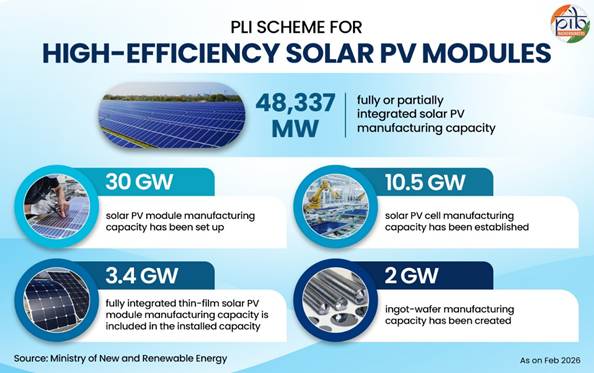
Solar energy sits at the heart of India's clean energy ambitions, demanding a strong domestic manufacturing base. The PLI Scheme for High-Efficiency Solar PV Modules, with an outlay of ₹24,000 crore, addresses this directly. The scheme promotes domestic manufacturing, reduces import dependence, and encourages value addition across the solar value chain. Under the scheme, letters of award have been issued for setting up 48,337 MW of fully/partially integrated solar PV module manufacturing capacity. By September 2025, the scheme had attracted investments of around ₹52,900 crore. It had also generated direct employment for about 44,400 people.
The Journey from Policy to Prosperity
What began as a policy experiment in 2020 has become a defining chapter in India's industrial history. PLI has done more than incentivise production- it has shifted the national mindset. Manufacturing is no longer a background activity but a strategic priority.
The real measure of PLI's success is not just in the numbers. It lies in the factories that didn't exist six years ago, the engineers now working on EV batteries, the farmers whose produce reaches global shelves. India is not just making more- it is making differently. As the next phase begins, the ambition is clear: not just to produce for the world, but to innovate for it.
References
Ministry of Electronics & IT
https://www.pib.gov.in/PressReleasePage.aspx?PRID=2247771®=3&lang=2
https://www.pib.gov.in/Pressreleaseshare.aspx?PRID=2108602&utm_source®=3&lang=2
Ministry of Commerce & Industry
https://www.pib.gov.in/PressReleasePage.aspx?PRID=2246089&utm_source®=3&lang=2
Ministry of Textiles
https://www.pib.gov.in/PressReleasePage.aspx?PRID=2250951®=3&lang=2
Ministry of Chemicals and Fertilizers
https://pharma-dept.gov.in/sites/default/files/Annual%20Report%202025-26.pdf
Ministry Of New and Renewable Energy
https://sansad.in/getFile/loksabhaquestions/annex/187/AS368_BC8yvX.pdf?source=pqals
https://www.pib.gov.in/PressReleasePage.aspx?PRID=2116602®=3&lang=2
Economic Survey 2025-26
https://www.indiabudget.gov.in/economicsurvey/doc/echapter.pdf
https://www.indiabudget.gov.in/doc/eb/vol1.pdf
NITI Aayog
https://www.niti.gov.in/sites/default/files/2026-11/Impact-Assessment-of-PLI-Schemes.pdf
PIB Archives
https://www.pib.gov.in/PressReleasePage.aspx?PRID=2254015®=3&lang=2
https://www.pib.gov.in/PressReleseDetailm.aspx?PRID=2234442®=3&lang=2
https://www.pib.gov.in/PressNoteDetails.aspx?NoteId=155082&ModuleId=3®=3&lang=2
https://www.pib.gov.in/PressNoteDetails.aspx?NoteId=155232&ModuleId=3®=3&lang=2
Click here to see pdf
*****
PIB Research
(Release ID: 2335931)
Visitor Counter : 176