Ministry of Social Justice & Empowerment
Hon’ble Prime Minister Shri Narendra Modi Chairs Plenary Session of ‘SAMAVESHI NITI SANKALP 2026’
Calls For Whole-Of-Government Approach To Build An Inclusive, Accessible And Drug-Free India
Centre And States Identify Time-Bound Action Points On Drug Demand Reduction, Scholarships, Early Intervention And Accessibility; Summit Reinforces Collective Commitment Towards Viksit Bharat @2047
Posted On:
19 NOV 2026 10:34PM by PIB Delhi
Hon’ble Prime Minister Shri Narendra Modi today applauded and commended the Ministry of Social Justice and Empowerment for organizing the Two Day Departmental Summit and facilitating meaningful deliberations. The Prime Minister emphasized the importance of collective action and a ‘Whole of Government’ approach in achieving the objectives of social justice, social empowerment and a Nasha Mukt Bharat.
Addressing the the plenary session of the two-day Departmental Summit titled ‘Samaveshi Niti Sankalp’, at the Sushma Swaraj Bhawan, in the National Capital here late this evening , Shri Modi highlighted the transformative impact of the Government’s welfare initiatives, he observed that nearly 50 crore people lifted out of poverty have experienced genuine social empowerment.
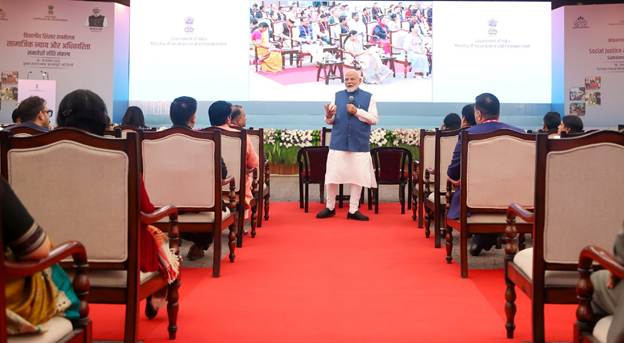
Calling for the Nasha Mukt Bharat Abhiyaan to be transformed into a nationwide Jan Andolan, the Prime Minister stressed that every citizen, family, educational institution and community must contribute to building a drug-free India. He encouraged schools to organize essay competitions and undertake awareness initiatives, while sensitizing parents to recognize early signs of substance abuse and addiction.
Emphasizing the importance of rehabilitation and social reintegration, Shri Modi observed that the journeys of individuals who have successfully overcome substance dependence carry a powerful message of hope. “These journeys carry the strongest message of hope. They show that recovery is possible and that a life free from drugs is a life of dignity,” he said.
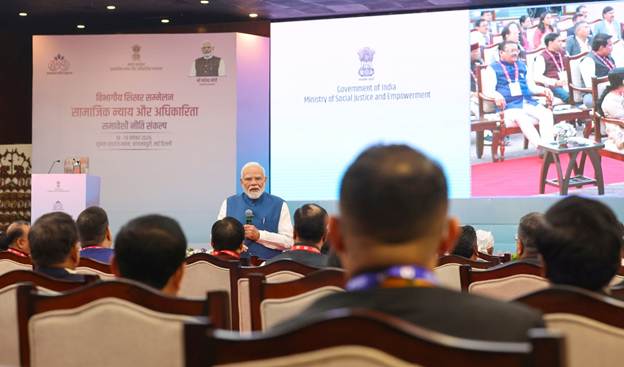
The Prime Minister also urged farmers to shun illicit crop cultivation and called for coordinated efforts involving all Ministries, State Governments, district administrations and spiritual organizations to strengthen the national campaign against drug abuse.
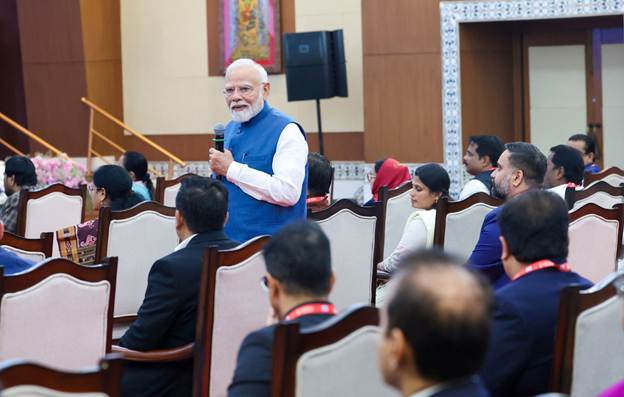
Recognising the influence of spiritual leaders, the Prime Minister said that spiritual gurus and organisations have a vital role to play in the mission. Their guidance, he noted, can inspire millions to choose a life free from drugs.
On the empowerment of persons with disabilities, the Prime Minister highlighted the significance of the term ‘Divyang’, noting its contribution towards enhancing the dignity, respect and self-esteem of persons with disabilities.
Shri Modi encouraged its wider use and popularization to foster a positive outlook towards Divyangjan across society. He also emphasized the need to identify, nurture and recognize their inherent talents and abilities by providing appropriate opportunities and platforms for their participation and contribution.
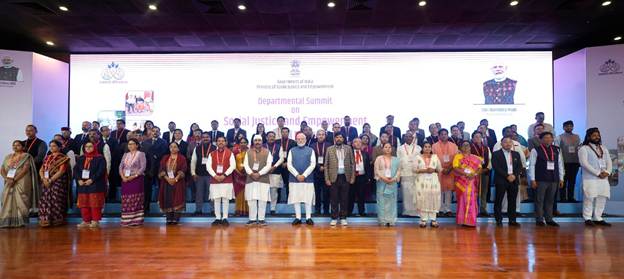
The Prime Minister’s address reinforced the need for sustained cooperation between the Centre and States, institutional convergence and effective implementation of welfare programmes to ensure that the benefits of development reach every section of society.
The Summit was attended by Union Ministers for Social Justice and Empowerment, Ministers from 27 States and Union Territories, Secretaries of both Departments, Secretaries from 35 States and Union Territories, and senior officers of the Ministry and participating State/UT administrations, to deliberate on key priorities and strengthen collaborative efforts towards inclusive social development and empowerment.
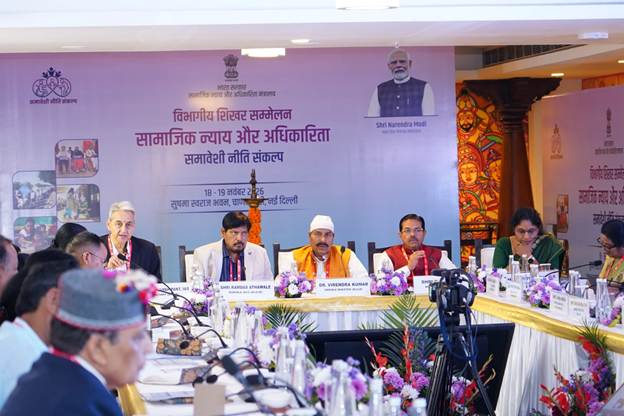
Four thematic priorities deliberated at the Summit
The two-day Departmental Summit commenced on November 18, 2026, with the inaugural session addressed by Union Minister for Social Justice and Empowerment Dr. Virendra Kumar. Context-setting remarks were delivered by the Secretaries of the Department of Social Justice and Empowerment (DoSJE) and the Department of Empowerment of Persons with Disabilities (DEPwD), outlining the policy priorities and implementation challenges relating to drug demand reduction, scholarships, early intervention and accessibility.
The first day on November 18 featured four thematic deliberations focusing on Re-imagining Prevention and Drug Demand Reduction for Nasha Mukt Bharat; Accessible Scholarships, Empowered Students; Early Intervention and Reduction of Disability Burden; and Sugamya Bharat for Viksit Bharat.
Four parallel breakout sessions provided a platform for Ministers and senior officials from States and Union Territories to exchange best practices, discuss implementation challenges and identify actionable measures with clearly defined timelines.
1. Re-imagining Prevention and Drug Demand Reduction for Nasha Mukt Bharat
The session, chaired by Dr. (Col.) Dhani Ram Shandil, Minister of Social Justice and Empowerment, Himachal Pradesh, and co-chaired by Shri Avinash Gehlot, Minister of Social Justice and Empowerment, Rajasthan, focused on transforming drug prevention and awareness efforts into a sustained Jan Andolan.
The key action points included observing the 10th of every month as Nasha Mukti Sankalp Diwas, beginning December 2026; making drug prevention a standing agenda item in every Gram Sabha and Municipal Ward; and establishing at least one de-addiction centre in every district by March 2029.
States shared several innovative initiatives, including Chandigarh’s VADA Clubs, Punjab’s SOORMA Ambassadors, Meghalaya’s DREAM Solace Home, Jammu and Kashmir’s 100 Days Campaign and Haryana’s STARS Rating for rehabilitation centres.
Dr. Shandil underscored the importance of structured and continuous interventions through families, schools and communities, observing that prevention is both sound public health policy and sound economics.
Shri Gehlot emphasised the need to move beyond government-led programmes towards community-driven participation.
Minister of State for Social Justice and Empowerment Shri B. L. Verma affirmed that the outcomes of the deliberations would inform the national action plan.
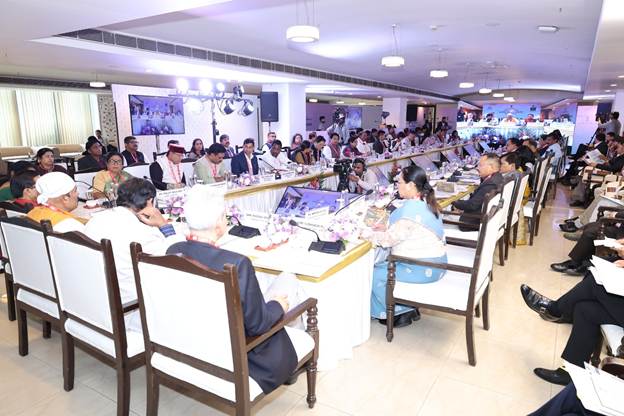
2. Accessible Scholarships, Empowered Students
Chaired by Shri Asim Arun, Minister in the Government of Uttar Pradesh, and co-chaired by Shri Kishan Kumar Bedi, Minister in the Government of Haryana, the session focused on developing an integrated, accessible and student-centric scholarship delivery ecosystem.
The deliberations emphasized simplification of application procedures, secure digital integration between the Centre and States, assisted application facilities, timely disbursement of scholarships and strengthened grievance redressal mechanisms. Suggestions relating to revision of income eligibility criteria and scholarship amounts were also discussed.
States highlighted successful initiatives, including common scholarship platforms in Odisha, Gujarat and Uttar Pradesh; Andhra Pradesh’s One Stop Scholarship Portal; prior scrutiny of applications in Madhya Pradesh; and auto-approval mechanisms adopted by Karnataka and Tamil Nadu.
The discussions underscored the importance of technology-enabled service delivery, intergovernmental coordination and transparent processes to ensure that eligible students receive scholarship assistance in a timely and hassle-free manner.
3. Early Intervention and Reduction of Disability Burden
The session, chaired by Dr. Shweta Gupta, Minister in the Government of Bihar, and co-chaired by Ms. Pi Lalrinpuii, Minister in the Government of Mizoram, focused on strengthening early identification, timely assessment and intervention for children with developmental delays and disabilities.
The key priorities included strengthening convergence among health, nutrition, education and disability-related services; expanding tele-rehabilitation and mobile outreach facilities; developing integrated digital tracking systems; and enhancing the availability of trained human resources.
West Bengal presented its SANSPARSH model, which facilitates community-level screening for Autism Spectrum Disorder (ASD) through a 20-point questionnaire.
Dr. Gupta highlighted that early identification and convergence of existing services are critical to reducing the burden of disability and ensuring that support reaches beneficiaries at the grassroots level.
Ms. Lalrinpuii emphasised the importance of parental awareness, continuous follow-up and shared responsibility among families, institutions and service providers.
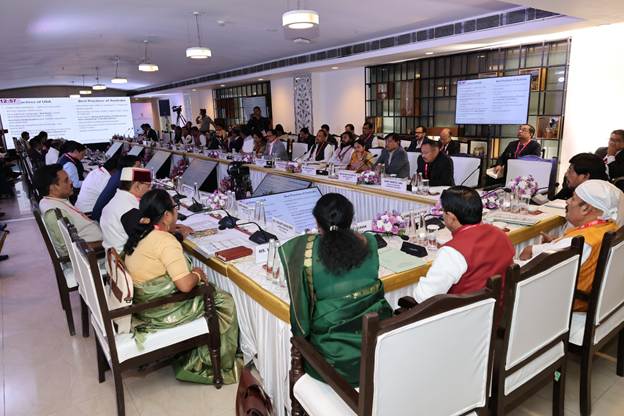
4. Sugamya Bharat for Viksit Bharat
The fourth thematic session focused on mainstreaming universal accessibility and inclusive design in public infrastructure, transport systems and digital services from the planning stage itself. The discussions highlighted the need for regular accessibility audits, effective monitoring mechanisms and active participation of persons with disabilities in the design and evaluation of public facilities.
States showcased several good practices, including Kochi Metro and Water Metro in Kerala, with Indian Sign Language-trained staff and accessible amenities; accessibility upgrades at Chennai Egmore and suburban railway stations in Tamil Nadu, including Braille-enabled lifts, tactile pathways and induction loops; accessible tourist spaces in Goa; level-boarding Ahmedabad Janmarg buses in Gujarat; and mandatory barrier-free infrastructure in schools in Assam.
Minister of State for Social Justice and Empowerment Shri B. L. Verma emphasised that accessibility is not an additional facility but the foundation of equal opportunities and a life of dignity, particularly in the context of the national vision of Viksit Bharat @2047.
Goa Minister Shri Subhash Faldessai advocated incorporating accessibility at the design and planning stage rather than relying on retrofitting.
Assam highlighted proposals for a dedicated National Mission, district-level monitoring and appropriate penalties for non-compliance with accessibility requirements.
Knowledge-sharing and exhibition of best practices
During the full-house sessions, experts Dr. Varsha Gathoo (formerly AYJNISHD) and Prof. J. S. Thakur (PGIMER) presented global best practices from the US, Australia, Switzerland, Iceland, Thailand, and the African Union alongside national policies.
An exhibition at Sushma Swaraj Bhawan showcased schemes, initiatives, success stories, digital applications and portals of both Departments, providing participants with an opportunity to understand innovative interventions and effective models of service delivery.
Renewed commitment to inclusive and empowered India
The deliberations culminated in a renewed commitment to strengthen Centre-State cooperation, institutional convergence and time-bound implementation of the agreed action points.
The Summit provided an important platform for translating policy priorities into coordinated action, leveraging successful State-level practices and addressing implementation gaps through collective responsibility.
With a shared focus on drug demand reduction, equitable access to educational opportunities, early intervention for persons with disabilities and universal accessibility, ‘SAMAVESHI NITI SANKALP 2026’ reaffirmed the Government’s commitment to building an inclusive, empowered, accessible and drug-free India in keeping with the vision of Viksit Bharat @2047.
****
PR-236-TAR/KV/GA/RK
(Release ID: 2338841)
Visitor Counter : 215