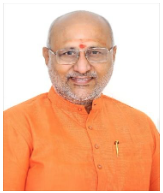
by Shri C.P. Radhakrishnan
For ages, Bharat’s unique distinction has been its noble vision of ‘Vasudhaiva Kutumbakam’ – of seeing the entire world as a single entity and all living beings as one. Rooted in the spiritual wisdom of Bharat, Yoga is an ancient discipline that harmonises body, mind, and spirit. The fundamentals of yoga include asanas – physical postures, pranayama - breathing techniques, and meditation. A combination of these elements of yoga enhances physical fitness, mental clarity, and emotional balance.
Hon’ble Prime Minister Narendra Modi Ji, while addressing the United Nations General Assembly, on September 27, 2014, highlighted the need to change people’s lifestyles to create a more habitable and sustainable world. He said that yoga embodies unity of mind and body; thought and action; restraint and fulfilment; harmony between man and nature; a holistic approach to health and well-being. At the behest of the Hon’ble Prime Minister, the United Nations General Assembly, on December 11, 2014, approved the proposal, co-sponsored by a record of over 174 countries, to declare June 21 as the International Day of Yoga. Since 2015, millions of people around the world gathered in public spaces to practice yoga together – transforming our ancient wisdom into a global movement.
On June 21 this year, as the Prime Minister, Shriman Narendra Modi Ji leads the Yoga Day in Kolkata, I am visiting Ladakh for the very same celebrations. Personally, for many years, I have also experienced the benefits of practicing Yoga and Panchakarma, which are often hailed as ‘sister sciences’. It is these deeply enriching personal experiences that have inspired me to pen down my reflections on Yoga and its profound impact on human well-being.
Yoga: A timeless legacy of Bharat
‘Yoga’ – a timeless practice for physical, mental, and spiritual well-being is believed to have started with the very dawn of our civilization. In the yogic lore, Lord Shiva is seen as the first yogi or Adi Yogi, and the first Guru or Adi Guru, while Maharishi Patanjali is hailed as the father of classical yoga for systematizing its principles in the Yoga Sutras. Maharishi Patanjali shares a deep spiritual association with Tamil Nadu. His physical Jeeva Samadhi is also believed to be located in Thirupattur.
Our revered Rishis and Munis gifted the world the invaluable treasure of Yoga. Through years of meditation, austerity, and spiritual inquiry, the rishis and sages developed a holistic system that unites the body, mind, and soul. Sri Ramakrishna Paramahamsa expounded the three great paths of Yoga—Jnana Yoga, the path of wisdom and knowledge; Karma Yoga, the path of selfless service and righteous action; and Bhakti Yoga, the path of pure love and devotion. He taught that all three paths ultimately converge in the realization of the Supreme Truth.
Yoga today transcends geographical, cultural, and religious boundaries, standing as a living testament to the timeless wisdom of India’s sages and their enduring contribution to the well-being of humanity.
Yoga for Healthy Ageing
Every year, International Yoga Day is celebrated enthusiastically in our country with a meaningful theme. This year’s theme of ‘Yoga for Healthy Ageing’ holds special significance. Remarkable advances in healthcare, public health systems, and declining mortality rates have increased human life expectancy across nations. Bharat too is witnessing this profound demographic transition. The India Ageing Report 2023, released by the United Nations Population Fund (UNFPA), states that by 2050, nearly one in five Indians will be above the age of 60.
While we celebrate this invaluable gift of longevity, it simultaneously places upon society a solemn responsibility of ensuring that added years to life also mean added life to years. Within this context, the theme for the International Day of Yoga (IDY) 2026 — “Yoga for Healthy Ageing” — emerges as a timely message.
This demographic transition has led to the emergence of expansion in the 'Silver Economy', focusing on the goods and services related to healthcare and the needs of senior citizens, in Bharat. Industry experts have estimated that this is nearly ₹73,000 crore as of now. This sector is expected to grow significantly in the coming years.
The realities of modern-day ageing have exposed how senior citizens navigate through a complex web of vulnerabilities. The World Health Organisation, in this context, has also repeatedly highlighted the growing burden of non-communicable diseases, mental health concerns, and social isolation among elderly populations across the world.
I also believe that now the pressing need of the hour is to initiate people into yoga at an early age. The earlier one begins the practice of Yoga, the greater the cumulative benefits throughout life. I am pleased to note that the National Education Policy 2020 accords Yoga a significant place as an integral component of health, wellness, and value-based education. This is a positive step in the direction of initiating the young into yoga. It will certainly serve as a means to cultivate discipline, concentration, emotional balance, and a healthy lifestyle among students.
Thus, we see that to successfully navigate the evolving demographic horizon across the world, Bharat offers the world a unique paradigm — one that harmoniously bridges ancient civilizational wisdom with modern scientific validation - YOGA.
Yoga - a solution for modern-day ageing
Today, modern science is increasingly validating the timeless insights of our sages and yogis who attained remarkable longevity, vitality, and mental clarity through disciplined living, yoga, and spiritual practice. Academic and clinical interest in the therapeutic dimensions of yoga has grown exponentially in recent years.
Premier institutions such as the National Institutes of Health (NIH), Harvard Medical School, and several peer-reviewed journals, such as Lancet, through their studies, have demonstrated that regular yoga practice safely improves balance, flexibility, and mobility among senior citizens, thereby significantly reducing the fear and risk of falls. Research has also shown measurable benefits of Yoga in improving bone density, alleviating arthritic pain, enhancing respiratory efficiency, stabilising blood pressure, and supporting mental well-being. Equally important, meditative and breathing practices have been found to improve sleep quality, emotional resilience, and cognitive functioning among the elderly.
But I would like to emphasise that the true strength of Yoga lies in its holistic nature. Beyond physical rehabilitation, Yoga nurtures emotional balance and social connectedness. I have witnessed that one of the deepest challenges of ageing today is the growing sense of isolation experienced by many seniors. Yoga gently transforms this inward loneliness into a broader sense of collective belonging. It encourages individuals to move from an “I-centric” orientation towards a “We-centric” consciousness rooted in empathy, interconnectedness, and inner peace.
Importantly, as per my own experiences, ‘Yoga For Healthy Ageing’ does not demand strenuous physical exertion. Classical yogic practices have been thoughtfully adapted into gentle and accessible protocols suitable for senior citizens. These include Yogic Sukshma Vyayama or subtle joint movements, chair-assisted postures, guided breathing techniques, and meditation practices that strengthen the neuroendocrine system and immunity without placing stress on ageing physiology.
At the same time, Yoga also serves as a source of resilience for caregivers and family members who shoulder the emotional and physical demands of elderly care. Recognising these immense benefits, the Ministry of Ayush has introduced the landmark initiative on “10 Yoga Protocols for Non-Communicable Diseases and Target Groups,” including a dedicated evidence-based Yoga module for geriatric health. Further, the Yoga 365 initiative, a nationwide campaign offering a free 100-day guided online Yoga programme, has been designed to ensure that Yoga becomes an accessible and enduring companion in everyday life for citizens across all age groups.
More than two thousand years ago, the great scholarly Tamil saint Thiruvalluvar advocated a personalized approach to health through the Kural (949), “Consider the patient's condition, the nature of the disease, and the proper time before undertaking treatment.” This timeless wisdom mirrors the modern principles of Yoga for Healthy Ageing, where practices are carefully adapted to an individual's age, health, and needs, enabling people to enjoy a healthier, more active, and more dignified life in their later years.
As we observe the International Day of Yoga 2026, I urge every citizen, educational institution, civil society organisation, healthcare professional, and community leader to embrace yoga not merely as an occasional exercise, but as a lifelong cultural and wellness practice. The true measure of a society lies in how it cares for its elderly. Let us therefore strive to create an ecosystem where our senior citizens live not in fear, dependence, or isolation, but with dignity, vitality, purpose, and peace. By making yoga a rhythm of life, we can collectively ensure that the golden years of our citizens truly become years of health, harmony, and fulfilment!
(The Author is Vice President of Bharat)