Textiles
Minister to inaugurate workshop on Integrated Skill Development Scheme
The Ministry of Textiles,
Government of India is organizing a National Workshop on Integrated Skill Development
Scheme (ISDS) at the national capital, on 27th August, 2015. The
workshop aims to showcase the successes under ISDS, share experiences and
obtain feedback from concerned stakeholders on how the scheme can better
contribute to a skilled India.
The workshop will be
inaugurated by the Union Minister of State for Textiles (I/C), Shri Santosh Kumar Gangwar. The Textiles Minister will also inaugurate an Exhibition at the
venue, namely India Habitat Centre. A brochure and a booklet on ISDS shall also
be released by the Minister.
Secretary, Textiles, Dr. Sanjay
Kumar Panda will launch the facility of online certificate generation through the
centralized Management Information System (MIS) portal of ISDS. This innovative
facility provides for easy, fast and seamless generation of certificates,
promising to be a boon to both trainees as well as training agencies.
Awards shall be given on
the occasion, to best performing implementing agencies and employers under the
scheme.
After
the inaugural session, a presentation shall be given on the journey of ISDS so
far. This shall be followed by sessions on the convergence of ISDS with the
‘Skill India’ initiative; the role of state Governments in catalysing skill
initiatives; standardization of courses, assessment and certification, and employment
opportunities and challenges under ISDS. The workshop thus aims to identify, disseminate,
evolve and institutionalize best practices to improve the effectiveness of the
scheme in building the skill capital of India’s textile sector.
Backgrounder on ISDS
Integrated
Skilled Development Scheme (ISDS) was introduced by Ministry of Textiles as a
pilot in the last two years of the 11th Five Year Plan year 2010 -11, in order to
address the manpower requirement of the diverse textile and related segments. The
scheme has subsequently been scaled up during the 12th plan with a target of
skilling 15 lakhs persons by the end of March 2017.
The
Government provides a grant subsidy to the extent of 75% of project cost with a
ceiling of Rs.10,000/- per trainee. The
scheme is being implemented by leveraging existing institutional strength and
training experience through three components:
- Institutions
/ Textile Research Associations under the Ministry of Textiles
- Private
industry partners in PPP mode
- State
Government Agencies
As
of now a total of 11.3 lakh training targets has been sanctioned under 76
projects to around 58 implementing agencies spread across India. The scheme has
experienced significant progress over the last 5 years and around 4.20 lakh
candidates have been successfully trained across diverse sectors like Apparel
and Garments, Textiles, Handlooms, Handicrafts, Sericulture, technical
textiles, Jute etc. During the year 2010, around six projects were sanctioned
under the scheme which has increased progressively to 57 in the year 2014 and
76 in the year 2015-16.
Midterm modification of scheme
guidelines
In
terms of the broad skill policy framework of the Government and ‘Make in India’
initiatives, the scheme has been revamped in FY 2014-15, with a view to
simplify procedures and to focus on partnering with industry for scaling up of
implementation of training programme with assured employment.
Reach of ISDS
The
scheme has a wide reach with training being conducted in almost all Indian
States/ UTs. Around 3,250 training centres
are present across different Indian states, cities and rural areas including
remote locations, backwards regions and left wing extremism affected areas.
Unique Features of ISDS
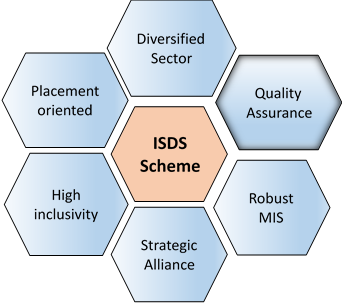
Various
initiatives have been undertaken by the Ministry of Textiles to strengthen the
institutional mechanism of the scheme. Steps have been taken to devise strong
monitoring norms and to enhance quality of training. In its continuous endeavour
towards digitization of skill development initiatives, several technology
initiatives have been adopted by the Ministry to keep pace with the dynamic and
evolving skilling domain.
- Sector
Skill Councils (SSCs): Three Sector Skill Councils (SSCs) have become operational as National
level apex bodies under the aegis of National Skill Development Corporation, in
the apparel, textiles, handloom & handicrafts sectors.
- A
web based centralized Management
Information System (MIS) has been operationalized for monitoring of all
aspects of the implementation of approved projects by implementing agencies. The MIS system has proved to be a remarkable
achievement in overall implementation and monitoring of the scheme.
- MIS is fully integrated
with biometric machines and real-time
inflow of biometric attendance has been made compulsory. This has helped Ministry
to track real-time progress of the scheme with the help of daily biometric
attendance.
- Placement with a
reasonable salary has been made a major yardstick of the scheme. All
implementing agencies are required to place 70% trainees in wage employment
with minimum wage prescribed for his /her skill category.
The
scheme will not only help overcome the shortage of skilled workforce in textile
sector, but also become driver of growth in the industry and trigger innovation
and scale, which are important for a competitive and sustainable textile
Industry in India.
DJM