PIB Backgrounder
India Hosts UNESCO’s 20th ICH Session
A landmark moment in safeguarding living heritage
Posted On:
07 DEC 2025 1:05PM by PIB Delhi
|
Key Takeaways
|
|
- India to host the 20th session of the UNESCO Intergovernmental Committee for Safeguarding of the Intangible Cultural Heritage from 8 to 13 December 2025 in New Delhi.
- For the Safeguarding of Intangible Cultural Heritage, UNESCO adopted the 2003 Convention in its 32nd General Conference in Paris.
- The Intergovernmental Committee advances the goals of the 2003 Convention and ensures its effective implementation across Member States.
- India has served on the UNESCO Intergovernmental Committee for three terms.
- To date, 15 Indian elements have been inscribed on the UNESCO Representative list.
|
Introduction
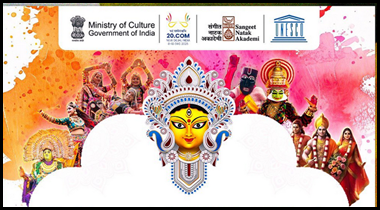
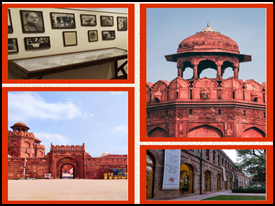
The Government of India will host the 20th session of the UNESCO Intergovernmental Committee for Safeguarding of the Intangible Cultural Heritage from 8 to 13 December 2025 in New Delhi. The historic Red Fort complex, a UNESCO World Heritage Site, has been chosen as the venue, symbolising the convergence of India’s tangible and intangible heritage under one roof.
This will be the first time that India hosts the ICH Committee session, and the meeting will be chaired by H.E. Vishal V. Sharma, India’s permanent delegate to UNESCO.The event coincides with the twentieth anniversary of India’s ratification of the 2003 Convention for Safeguarding of the Intangible Cultural Heritage in 2005, underscoring India’s sustained commitment to preserving living cultural traditions.
Intangible cultural heritage, as UNESCO defines it, include the practices, knowledge, expressions, objects, and spaces that communities see as part of their cultural identity. Passed down over generations, this heritage evolves, strengthening cultural identity and appreciation of diversity.
Historical Background

For the Safeguarding of Intangible Cultural Heritage, UNESCO adopted the 2003 Convention on 17thOctober 2003 during its 32nd General Conference in Paris. The Convention responded to global concerns that living cultural traditions, oral practices, performing arts, social customs, rituals, knowledge systems, and craftsmanship were increasingly threatened by globalisation, social change, and limited resources.
The Convention placed communities, especially indigenous communities, groups, and individual practitioners, at the heart of safeguarding efforts, acknowledging their vital role in creating, maintaining and transmitting cultural heritage. It underscored the interdependence between tangible and intangible heritage, the need for global cooperation, and the importance of raising awareness among younger generations. With a shared global commitment to protecting humanity’s living heritage, the Convention formally established mechanisms for international cooperation, support, and recognition, laying the foundation for UNESCO’s Intangible Cultural Heritage lists and the subsequent work of the Intergovernmental Committee.
The purposes of this Convention are
- To safeguard the intangible cultural heritage;
- To ensure respect for the intangible cultural heritage of the communities, groups and individuals concerned;
- To raise awareness at the local, national and international levels of the importance of the intangible cultural heritage, and ensuring mutual appreciation thereof;
- To provide for global cooperation and assistance.
Functions of the Intergovernmental Committee
The Intergovernmental Committee for Safeguarding of the Intangible Cultural Heritage advances the objectives of the 2003 Convention and ensures their effective implementation across Member States. In fulfilling this mandate, the committee:
- Promotes and monitors the objectives and implementation of the 2003 Convention.
- Provides guidance on best practices and recommends measures for safeguarding intangible cultural heritage.
- Prepares and submits to the General Assembly the draft plan for the use of the Intangible Cultural Heritage Fund.
- Mobilises additional resources for the Fund in accordance with the Convention’s provisions.
- Drafts and proposes operational directives for the implementation of the Convention.
- Examines periodic reports submitted by States Parties and compiles summaries for the General Assembly.
- Evaluates requests from States Parties and makes decisions regarding:
- Inscription of elements on UNESCO’s ICH Lists (as per Articles 16, 17 and 18).
- Granting of international assistance.
20th Session of Intergovernmental Committee
The Ministry of Culture (MoC), Government of India and its autonomous body, the Sangeet Natak Akademi (SNA) are the nodal agencies to host the 20th Session of the Intergovernmental Committee at the Red Fort (Lal Qila) in New Delhi. This magnificent 17th-century fort in Delhi, known for its stunning red sandstone walls and grand architecture, palaces, gardens, and museums is itself on the UNESCO World Heritage list.
Key Agendas
By hosting the 20th session of the ICH Committee, India aims to:
- Present and share its national ICH safeguarding model — combining institutional support, community participation, documentation and national inventory efforts — as a global good practice.
- Encourage increased international cooperation via collaborative nominations, joint safeguarding initiatives, capacity building, sharing of resources, technical exchange.
Bring greater global visibility to India’s intangible heritage — including lesser-known traditions, local crafts, regional festivals — thereby attracting global support, interest, research, tourism and resource mobilisation.
- Use the session’s global spotlight to motivate further domestic efforts such as documentation, inventorying, nomination dossiers, community engagement, especially among youth and future generations.
- Provide a platform for cultural diplomacy: project India’s soft-power, cultural richness, diversity and heritage leadership on a global stage.
- Strengthen the link between heritage conservation and sustainable development: intangible heritage as a resource for livelihoods, community identity, social cohesion, and cultural tourism.
India’s Intangible Cultural Heritage: A National & Global Asset
India’s intangible cultural heritage is not just a matter of tradition or nostalgia, it is a living asset with deep social, economic, educational, and diplomatic value.
- Social & Cultural Identity: ICH preserves linguistic, ethnic, regional, tribal, religious and community identities – fostering social cohesion and pluralism in a diverse nation like India.
- Livelihoods & Crafts Economy: Traditional crafts, performing arts, craftsmanship, and cultural tourism provide livelihoods to artisans, performers, craftspeople — often in rural or marginalised communities. Institutional support under the ICH Scheme can help sustain these livelihoods, prevent skill loss, and promote inclusive development.
- Education & Transmission of Knowledge: Many intangible heritage forms embed traditional knowledge — ecological practices, oral histories, craftsmanship techniques, folklore, rituals, indigenous wisdom. When documented and transmitted, these strengthen education, deepen cultural literacy and ensure intergenerational continuity.
- Cultural Diplomacy & Soft Power: Dances, festivals, crafts, oral traditions — reflects India’s diversity, unity, values, and cultural depth. Promoting them globally enhances India’s soft power, cultural diplomacy and international image. Hosting the session further amplifies this impact.
- Global Heritage Governance & Leadership Role: With its vast heritage landscape, India’s active participation and role as host strengthen global heritage governance under UNESCO. It positions the nation as a key voice among developing countries, advocating for balanced, inclusive, and community-sensitive approaches to heritage preservation globally.
India’s Contributions to ICH
India’s vast and diverse intangible cultural heritage—encompassing living traditions, oral expressions, performing arts, rituals, crafts, and community practices—requires systematic institutional support for its preservation and transmission. To address this need, the Ministry of Culture launched the “Scheme for Safeguarding the Intangible Heritage and Diverse Cultural Traditions of India” as a centralised mechanism to strengthen ongoing but scattered preservation efforts. Meanwhile, the Sangeet Natak Akademi (SNA) organizes capacity-building workshops to train individuals and increase awareness about the Intangible Cultural Heritage (ICH).
The Scheme aims to revitalise institutions, practitioners, communities, scholars, and organizations engaged in safeguarding ICH, while enhancing national and international recognition of India’s cultural traditions, including through UNESCO nominations. It supports a wide range of stakeholders—universities, state governments, NGOs, cultural bodies, researchers, and individual practitioners.
Key activities under the Scheme include documentation and creation of ICH inventories; preservation and promotion of cultural expressions; preparation of UNESCO nomination dossiers; training and capacity building for artists; workshops and performances; dissemination initiatives; education–culture integration; and support for skill development through Sector Skill Councils under the National Vocational Educational Qualifications Framework (NVEQF).
India’s Intangible Cultural Heritage Inscribed by UNESCO
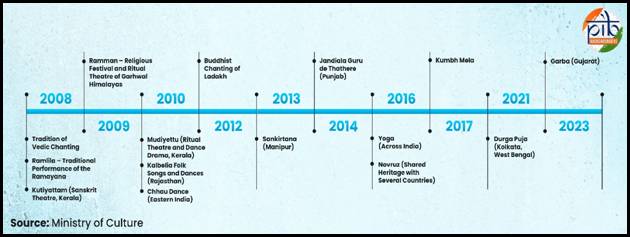
India, as a State Party to the UNESCO 2003 Convention for Safeguarding of the Intangible Cultural Heritage, has actively advanced the preservation of its living cultural traditions through national institutions such as the Ministry of Culture and the Sangeet Natak Akademi. To date, 15 Indian elements have been inscribed on UNESCO’s Representative List of the Intangible Cultural Heritage of Humanity, reflecting the country’s extraordinary civilisational depth and cultural continuity.
Did You Know?
This year, India has nominated Chhath Mahaparva and Diwali for UNESCO’s ICH List.
|
These inscriptions also reflect India’s commitment to safeguarding diverse cultural expression through community participation, documentation, training, and transmission, principles central to the 2003 convention. These inscriptions range from ancient performing arts like Kutiyattam and Chhau, to sacred traditions such as Vedic chanting, Buddhist chanting in Ladakh, and community-based practices like Ramlila, Ramman, and Sankirtana. Everyday cultural knowledge systems are equally represented through the metalcraft of the Thatheras of Jandiala Guru, the Kalbelia community’s dynamic music and dance, and large-scale social-spiritual gatherings like the Kumbh Mela. Elements such as Yoga, Durga Puja, and Garba showcase India’s vibrant contemporary cultural identity, while Novruz, celebrated across several countries including India, highlights regional cultural interconnectedness.
India’s hosting of the 20th UNESCO Intergovernmental Committee session marks a milestone, blending symbolic significance with a real chance to lead. With a strong heritage infrastructure and history of cultural diversity, India is ready to showcase and share its safeguarding model. This event offers India an opportunity to highlight its living heritage, foster global cooperation, and shape a renewed approach to preserving intangible cultural heritage for current and future generations.
The success of the 20thsession of the Intergovernmental Committee in New Delhi will reflect positively on UNESCO, the Government of India, and the vitality of India’s cultural traditions. India’s heritage lives through its people, expressed in its languages, arts, rituals, festivals, and belief systems. Hosting this year’s session shows India’s enduring commitment to safeguarding its cultural legacy for future generations.
References
UNESCO
https://ich.unesco.org/en/what-is-intangible-heritage-00003
https://ich.unesco.org/en/20com
https://ich.unesco.org/en/state/india-IN?info=elements-on-the-lists
https://ich.unesco.org/en/news/india-to-host-the-20th-session-of-the-committee-in-2025-13542
https://www.unesco.org/en/intangible-cultural-heritage/committee-2025
Ministry of Culture
https://20com2025.culture.gov.in/intangible_cultural_heritage_in_India
https://20com2025.culture.gov.in/session_venue
https://20com2025.culture.gov.in/home#:~:text=All%20participants%20as%20well%20as%20the%20general,stream%20from%208th%20to%2013th%20DECEMBER%202025.
https://culture.gov.in/intangible-cultural-heritage
SANGEET NATAK AKADEMI
https://www.sangeetnatak.gov.in/sections/ICH
IGNCA
https://ignca.gov.in/divisionss/janapada-sampada/loka-parampara/intangible-cultural-heritage/inventory-on-the-intangible-cultural-heritage/
PIB
https://www.google.com/url?sa=t&source=web&rct=j&opi=89978449&url=https://static.pib.gov.in/WriteReadData/specificdocs/documents/2024/jul/doc2024715349801.pdf&ved=2ahUKEwiLjP_hho2RAxWtcGwGHTeMJmIQFnoECCIQAQ&usg=AOvVaw3yJyfq0iCsZHp_aBrRtEn6
https://www.pib.gov.in/PressReleaseIframePage.aspx?PRID=1839891
https://www.pib.gov.in/PressReleasePage.aspx?PRID=2122423
https://www.pib.gov.in/PressNoteDetails.aspx?id=154536&NoteId=154536&ModuleId=3
https://www.pib.gov.in/PressReleasePage.aspx?PRID=2153599
See in PDF
***
RK
(Release ID: 2199982)
Visitor Counter : 7315