PIB Backgrounder
National Consumer Day
“Efficient and Speedy Disposal through Digital Justice”
Posted On:
23 DEC 2025 1:35PM by PIB Delhi
Introduction
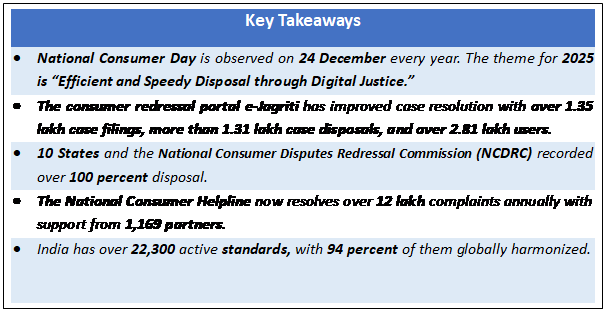
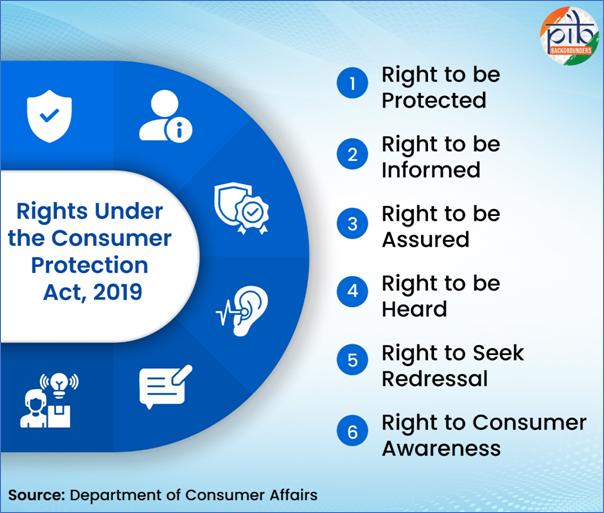
National Consumer Day is observed in India on 24 December each year to highlight the significance of consumer rights and the broader framework of consumer protection. It was on this day that the Consumer Protection Act, 1986, received the President's assent, establishing a comprehensive set of rights for consumers. These include the right to be protected, the right to be informed, the right to be assured, the right to be heard, the right to seek redressal, and the right to consumer awareness. The observance aims to raise awareness and promote responsible practices among consumers and other stakeholders. In 2025, National Consumer Day is guided by the theme “Efficient and Speedy Disposal through Digital Justice,” reflecting India’s continued focus on technology-enabled, accessible, and timely consumer grievance redressal.
Reimagining Consumer Rights: Stronger Laws, Faster Redressal, and Better Outcomes
The Consumer Protection Act, 2019, represents a significant reform in the safeguarding of consumer interests in India. Enacted on 20 July 2020, it supersedes the Consumer Protection Act of 1986and introduces a more contemporary framework for dispute resolution and marketplace accountability. The Act seeks to safeguard consumer welfare and promote fairness in commercial transactions by facilitating informed decision-making, ensuring uniform and equitable outcomes, and enabling prompt and effective grievance redressal. The law guarantees several key rights, including the right to be informed about the quality, quantity, potency, purity, and standards of goods or services, thereby safe guarding consumers against unfair trade practices. To operationalise its objectives, the Act establishes a three-tier adjudicatory structure for consumer dispute resolution:
- District Consumer Disputes Redressal Forum (District Forum) - the first tier, located at the district court, adjudicates complaints involving claims up to Rs. 50 lakhs.
- State Consumer Disputes Redressal Commission (State Commission) - the second-tier, state-level body deals with complaints exceeding Rs. 50 lakhs and up to Rs. 2 crore.
- National Consumer Disputes Redressal Commission (National Commission) - the apex tier, operating at the national level, addresses complaints involving complaints above Rs. 2 crore.
|
In July 2025, 10 States, along with the National Consumer Disputes Redressal Commission (NCDRC) recorded a disposal rate of more than 100 percent. This indicates that the volume of cases resolved during the month surpassed the number of newly filed cases, demonstrating enhanced efficiency and a reinforced commitment to delivering timely consumer justice.
|
The District Forum and State Commission are constituted by individual State Governments with the approval of the Central Government, whereas the National Commission is established directly by the Central Government. These adjudicatory bodies do not supersede the jurisdiction of civil courts, instead, they provide an alternative mechanism for resolving consumer grievances.
Role and functions of the Central Consumer Protection Authority (CCPA)
The Central Consumer Protection Authority (CCPA), established on 24 July 2020 under the Consumer Protection Act, 2019, serves as a regulatory body mandated to safeguard the interests of consumers as a collective. It functions encompass:
- Protecting, promoting, and enforcing the rights of consumers
- Preventing the occurrence of unfair trade practices
- Ensuring goods and services are not sold in violation of the Act
- Monitoring and regulating advertisements to prevent false or misleading claims
- Initiating actions against manufacturers, endorsers, and publishers involved in disseminating misleading advertisements
The CCPA is empowered to mandate the recall of unsafe goods and services, discontinue unfair trade practices, levy penalties, and initiate prosecution when required.
Catalysing Consumer Protection Initiatives: The Consumer Welfare Fund
The Consumer Welfare Fund aims to support initiatives that protect consumer interests and strengthen the consumer movement across the nation. Financial assistance is extended to States and Union Territories for the establishment of a Consumer Welfare Corpus Fund, with contributions structured on a 75:25ratio, and on a 90:10ratio for Special Category States and designated Union Territories. Programme activities are funded through the interest accrued on this corpus. During the financial year 2024-25 (as on 31.12.2024), an amount of Rs.38.68 Crore has been released to the States/UTs.
Building a Responsive and Reliable Consumer Redressal Framework
A responsive and reliable consumer redressal system is crucial for providing individuals with timely and equitable solutions to grievances arising from the purchase of goods or services. Strengthening this system not only builds trust in the marketplace but also empowers consumers by ensuring that their concerns are recognised, addressed, and resolved in an efficient manner.
- e-Jagriti - Revolutionizing Consumer Justice in 2025
e-Jagriti, launched on 1 January 2025, has rapidly emerged as a significant digital platform for consumer grievance redressal in India. It integrates earlier systems, including OCMS, e-Daakhil, NCDRC CMS, and CONFONET, into a single, streamlined interface, thereby enhancing accessibility and simplifying procedures. Now operational across the NCDRC and all States and Union Territories, the platform enables users to file complaints, make payments, participate in virtual hearings, and monitor case progress. Its multilingual support, chatbot assistance, voice-to-text features, and secure digital access ensure usability for all consumers, including senior citizens and persons with disabilities.
Key Benefits of e-Jagriti
- Global Accessibility: The platform allows both non-resident Indians and domestic users to file and manage cases remotely, supported by secure end-to-end encryption and role-based secure access.
- Efficiency and Speed: Automated workflows, real-time SMS and email notifications, and virtual hearings have significantly improved the overall efficiency of the system. Notably, ten states and the NCDRC have recently recorded disposal rates exceeding 100 percent.
- Inclusivity: The platform offers multilingual interfaces and accessibility features, making it user-friendly for people from diverse linguistic and socio-economic backgrounds.
- Secure Transactions: Integration with Bharat Kosh and PayGov payment gateways ensures that fee payment processes are efficient, secure, and user-friendly.
|
Justice Delivered for a Consumer in Tripura
A consumer in West Tripura secured relief after enduring 8 years of issues with a Rs.85,000 LG Side by Side refrigerator that leaked water and failed to defrost despite repeated repairs. The case, filed as DC/272/CC/33/2025, was resolved within 5 months with the Commission holding LG India and the service centre liable for deficiency in service and unfair trade practices.
The order awarded a full refund with 7.5 percent annual interest, along with Rs.12,000 towards repair expenses, Rs.50,000 for mental agony and Rs.20,000 for litigation, totalling more than Rs.1.67 Lakh, to be paid within 30 days. The outcome shows that e-Jagriti continues to empower consumers and hold brands accountable for long term service responsibilities.
|
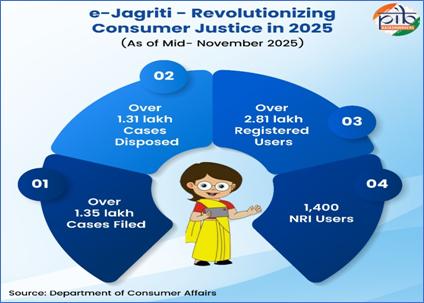
As of mid- November 2025, the platform has facilitated the filing of over 1.35 lakh case filings and enabled the disposal of over 1.31 lakh cases, supported by a user base of over 2.81 lakh registered individuals, including 1,400 non-resident Indians (NRIs). A total of 466 complaints were filed by Non-Resident Indians from countries including the United States (146), the United Kingdom (52), the UAE (47), Canada (39), Australia (26), and Germany (18).
In 2025, e-Jagriti demonstrated a marked enhancement in case disposal efficiency. Between July and August, 27,545 cases were resolved, compared with 27,080 newly filed. During September and October, 24,504 cases were disposed of, against 21,592 newly filed. Both intervals show performance levels surpassing those of 2024, reflecting faster clearance of pending cases and more effective grievance redressal. Additionally, the platform has issued over 2 lakh SMS alerts and more than 12 lakh email notifications, ensuring real-time communication and timely compliance.
- National Consumer Helpline 2.0
The Department of Consumer Affairs has upgraded the National Consumer Helpline (NCH)with the introduction of AI-enabled NCH 2.0, offering multilingual assistance, chatbot-supported interactions, and expedited grievance resolution. The portal enables consumers to register complaints online, seek pre-litigation remedies, and access information regarding their rights. The National Consumer Helpline has substantially expanded its outreach and operational efficiency by integrating advanced technological solutions. The number of calls received by NCH has grown nearly tenfold, from 12,553 calls in December 2015 to 1,55,138 calls in December 2024. This exponential growth reflects the rising confidence of consumers in the helpline. Similarly, the average number of complaints registered per month has surged from 37,062 in 2017 to 1,11,951 in 2024. It now resolves over 12 lakh complaints annually, with many being addressed within 21 days, supported by 1,169 companies onboarded as partners and AI-based systems that ensure faster grievance resolution. Digital channels account for nearly 65 percent of grievance registrations, with a notable increase in WhatsApp-based submissions, rising from 3 percent in March 2023 to 20 percent in March 2025. The National Consumer Helpline (NCH) has successfully facilitated a refund of Rs.27.61 crore to consumers between 25th April 2025 and 31st October 2025. This significant redressal was achieved across 30 sectors, effectively addressing 49,333 consumer grievances related to refund claims.
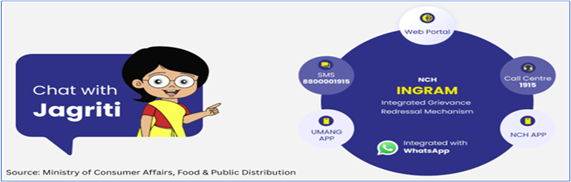
The National Consumer Helpline is available in 17 languages and enables consumers to submit grievances through the Integrated Grievance Redressal Mechanism via multiple channels, including WhatsApp, SMS, email, the NCH app, the web portal, and the Umang app. The Department encourages consumers to utilize the toll-free number 1915 or the online portal to ensure that their concerns regarding goods or services are addressed promptly and effectively.
- Jago Grahak Jago Portal and Mobile App
The Department of Consumer Affairs has implemented advanced digital tools to safeguard consumers from deceptive online practices. Developed as part of a real-time intelligent cyber-physical system on the Airawat AI Supercomputer, these tools analyse platform text and design to identify potential dark patterns. The Jago Grahak Jago App offers verified e-commerce information and alerts users to potentially unsafe websites, while the Jagriti App enables consumers to report suspicious URLs directly to the Central Consumer Protection Authority. The Jagriti Dashboard further supports monitoring by providing real-time assessments of platforms. Collectively, these tools enhance oversight, facilitate swift corrective action, and reinforce the protection of consumer rights.
|
Dark patterns are design tactics used to mislead or pressure consumers into choices they may not intend to make. The CCPA has addressed this issue by issuing guidelines that curb practices such as drip pricing, disguised advertisements and false urgency, ensuring greater fairness and transparency in the digital marketplace.
|
- Bureau of Indian Standards (BIS)
The Bureau of Indian Standards serves as India’s national standard body under the BIS Act, 2016. It plays a central role in the formulation of standards, product certification, and quality assurance. Through its activities in standard development, certification, and testing, BIS contributes to the availability of safe and reliable products, mitigates health risks for consumers, supports export competitiveness and import substitution, and prevents unnecessary variation in product specifications across the market.
Over 22,300 Indian Standards are in force, with 94 percent aligned with international norms established by the International Organization for Standardization (ISO) and International Electrotechnical Commission (IEC). Since 2014, the scope of mandatory certification has expanded significantly, from 106 products governed by 14 Quality Control Orders (QCOs) to 773 goods now regulated through 191 QCOs plus two horizontal QCOs.
Hallmarking of Gold and Silver Jewellery- BIS Care App
The BIS Care app enables consumers to easily verify hallmarked jewellery by simply entering the HUID number to check purity, product type, and details of the jeweller and hallmarking centre. Available free on both Android and iOS in 12 languages, it also allows users to verify ISI marks, check licence numbers, and register complaints about suspected non-compliant products. The app serves as a valuable tool for informed purchasing and supports BIS efforts to ensure the availability of safe products and fair-trade practices for consumers nationwide.
- National Test House
The National Test House (NTH) functions under the administrative control of the Department of Consumer Affairs in the Ministry of Consumer Affairs, Food, and Public Distribution, and is one of India’s leading scientific institutions. Established in 1912 under the Railway Board, it has grown into a trusted laboratory for testing, calibration, evaluation, and quality control of a wide range of engineering materials and finished products. NTH issues test certificates that comply with national and international standards as well as customer-specific requirements, ensuring reliability and quality in assessment. The institution plays an important role across industry, trade, and standardisation, supporting the growth of indigenous manufacturing and acting as a vital link between industrial research and production.
The National Test House is modernising its operations through the adoption of digital solutions. The Laboratory Data Automation System (LDAS) is being introduced to reduce manual errors, shorten turnaround times, and expedite the completion of quality tests, thereby enhancing overall capacity and efficiency. Additionally, a new mobile application will enable both industry and consumers to access laboratory services more easily, streamlining engagement and improving service delivery. The recent performance of NTH reflects its strong growth, with sample testing increasing by 60.36 percent to 45,926 samples in 2024-25, and revenue rising by 49.89 percent to Rs.44.45 crore, compared to Rs.29.66 crore in the previous year with targeted revenue for FY 2025–26 being Rs.80 crore.
- The Legal Metrology Rules- Recent Amendments (2025)
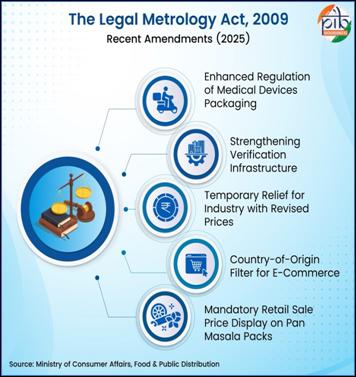 In October 2025, the Department of Consumer Affairs notified the Legal Metrology (Packaged Commodities) Amendment Rules, 2025, specifying that medical device packages will now adhere to the labeling requirements outlined in the Medical Devices Rules,2017. In October 2025, the Legal Metrology (Government Approved Test Centre) Amendment Rules, 2025, were notified, expanding the scope of approved test centres by recognizing regional reference laboratories and national test houses. To support compliance following GST-linked price revisions, the government has allowed manufacturers and packers to use existing packaging until March 2026. Under the 2025 relaxations, they may update MRPs without redesigning packages, ensuring regulatory adherence while easing business operations. In November 2025, the department issued the Draft Legal Metrology (Packaged Commodities) (Second) Amendment Rules, 2025, proposing to make it mandatory fore-commerce platforms selling imported packaged goods to offer a searchable and sortable filter by ‘Country of Origin’. In December 2025, a new amendment made it mandatory for all pan masala packages, regardless of size, to display the Retail Sale Price along with all other required declarations as of 1 February 2026.
Overall, these amendments streamline regulatory requirements, eliminate earlier ambiguities, and enhance clarity across various sectors, including medical device labeling, measurement verification, and the packaging of goods. By expanding the verification network, strengthening disclosure norms, and tightening pricing transparency, the reforms collectively enhance consistency, accountability, and consumer protection. Furthermore, they support a more reliable regulatory environment that empowers consumers to make informed choices and ensures fairer market practices.
Conclusion
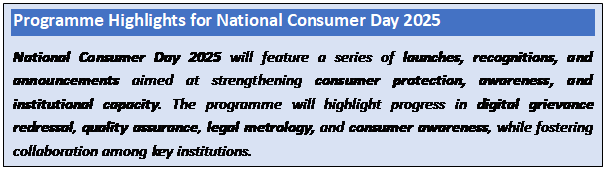
National Consumer Day 2025 highlights India’s ongoing commitment to safeguarding consumer rights and promoting trust in the marketplace. The theme “Efficient and Speedy Disposal through Digital Justice” is evident in the continued expansion of digital grievance redressal platforms such as e-Jagriti and the upgraded National Consumer Helpline, which have improved access, transparency, and disposal efficiency across the country. The wide range of programme activities, including digital launches, institutional collaborations, awareness initiatives, and recognition of innovation, underscores a coordinated approach to consumer empowerment.
The reforms and initiatives highlighted, including the Consumer Protection Act, 2019, the establishment of the Central Consumer Protection Authority, expansion of the Consumer Welfare Fund, and the advancement of accessible grievance redressal systems, reflect a shift towards a responsive and technology-driven consumer justice system. Progress through BIS, National Test House, and the Legal Metrology framework has further strengthened quality assurance, standardisation, and accuracy in trade. Collectively, these measures demonstrate steady progress towards a fair, transparent, and consumer-centric ecosystem, reinforcing the core message that informed and empowered consumers are central to a healthy and equitable economy.
References
Ministry of Consumer Affairs, Food & Public Distribution
Department of Consumer Affairs
https://consumeraffairs.gov.in/public/upload/files/1743657766_AR%202024-25_Eng_1744632582.pdf
https://consumeraffairs.gov.in/
https://doca.gov.in/ccpa/
https://e-jagriti.gov.in/
https://jagograhakjago.gov.in/
https://www.bis.gov.in/the-bureau/about-bis/?lang=en
https://consumeraffairs.gov.in/pages/legal-metrology-overview
https://consumeraffairs.gov.in/pages/national-test-house
PIB Press Releases
https://www.pib.gov.in/PressReleasePage.aspx?PRID=2157241
https://www.pib.gov.in/PressReleasePage.aspx?PRID=2190535®=3&lang=2
https://www.pib.gov.in/PressReleasePage.aspx?PRID=2179780®=3&lang=2
https://www.pib.gov.in/PressReleasePage.aspx?PRID=2087600®=3&lang=2
https://www.pib.gov.in/PressReleasePage.aspx?PRID=2187416®=3&lang=2
https://www.pib.gov.in/PressReleasePage.aspx?PRID=2088051®=3&lang=2
https://www.pib.gov.in/PressReleasePage.aspx?PRID=2087245®=3&lang=2
https://www.pib.gov.in/PressReleseDetailm.aspx?PRID=2077618®=3&lang=2
https://www.pib.gov.in/PressReleasePage.aspx?PRID=2178951®=3&lang=2
https://www.pib.gov.in/PressReleasePage.aspx?PRID=2111506®=3&lang=2
https://www.pib.gov.in/PressReleasePage.aspx?PRID=2198764®=3&lang=1
https://www.pib.gov.in/PressReleasePage.aspx?PRID=2183777
https://www.pib.gov.in/PressReleasePage.aspx?PRID=2184053
https://www.pib.gov.in/PressReleasePage.aspx?PRID=2168208
https://www.pib.gov.in/PressReleasePage.aspx?PRID=2188363
https://www.pib.gov.in/PressReleasePage.aspx?PRID=2198215
https://www.pib.gov.in/PressReleasePage.aspx?PRID=2165412®=3&lang=2
Click here to download PDF
*****
PIB Research
(Release ID: 2207673)
Visitor Counter : 8817