Technology
Electronics Components Manufacturing Scheme
प्रविष्टि तिथि:
17 SEP 2026 12:51 AM
Building India’s Electronics Backbone
ECMS for making India self-reliant in the electronics supply chain
Electronics have become integral to modern economies and everyday life. They power communication, healthcare, transport, finance, manufacturing and digital infrastructure. From smartphones and automobiles to telecom networks and industrial systems, electronics drive technological progress and economic competitiveness. A strong domestic electronics ecosystem is therefore critical for technological resilience, economic security and national self-reliance.
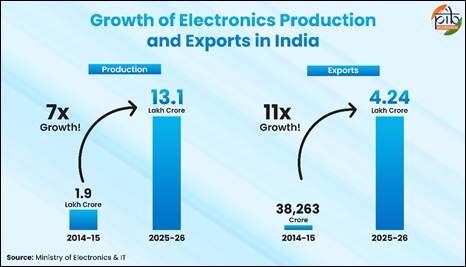
India’s electronics manufacturing sector has witnessed remarkable expansion over the past decade. Electronics production increased from ₹1.9 lakh crore in 2014–15 to ₹13.11 lakh crore in 2025–26. Electronics exports grew from ₹38,000+ crore to ₹4.24 lakh crore during the same period. This sustained growth has established a strong foundation for India’s electronics manufacturing ambitions. The next priority is to deepen this ecosystem through domestic component manufacturing, higher value addition and stronger supply-chain resilience.
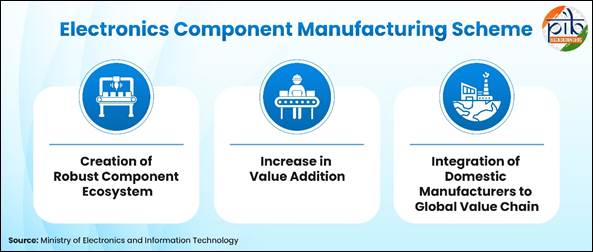
The Electronics Component Manufacturing Scheme (ECMS) is designed to drive this transition. Several critical components and materials remain import-dependent. These include printed circuit boards, camera and display modules, connectors, capacitors, lithium-ion cells and rare-earth magnets. ECMS supports domestic manufacturing across components, sub-assemblies, supply-chain products and related capital goods. It seeks to increase domestic value addition and reduce import dependence. The scheme also aims to strengthen resilience across India’s electronics supply chain. By building capabilities deeper within the electronics value chain, ECMS aims to convert India’s manufacturing momentum into a self-reliant and globally competitive electronics ecosystem.
|
SEMICON 2026: Catalyzing India’s Semiconductor Ecosystem
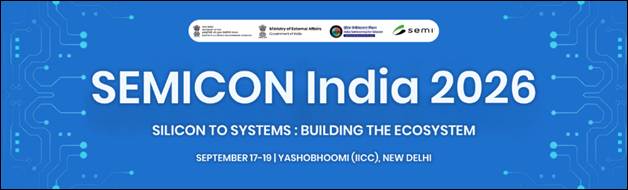
Semiconductors form the core of modern electronic systems. Building a strong semiconductor ecosystem is therefore essential for technological resilience, economic security and national self-reliance. Recognising this strategic importance, the Government of India is strengthening the semiconductor ecosystem through policy support, infrastructure and global partnerships. In this endeavours, SEMICON India 2026, themed “Silicon to Systems: Building the Ecosystem,” was inaugurated by Prime Minister Shri Narendra Modi at Yashobhoomi, New Delhi, on 17 September 2026. Being held from 17 to 19 September 2026, the SEMICON 2026 brings together global industry leaders, policymakers, investors, academia and start-ups. It provides a platform to advance India’s semiconductor ambitions and strengthen the ecosystem across the entire value chain. Click To Explore Agenda
|
ECMS Progress So Far: From Policy to Production
The Electronics Component Manufacturing Scheme is accelerating the development of a robust and deep-rooted ‘Swadeshi’ electronics value chain, moving beyond assembly to domestic manufacturing of critical components and essential raw materials.
- ECMS was notified on 8 April 2025. It was launched with an initial outlay of ₹22,919 crore.
- The scheme has a six-year tenure, with an optional one-year gestation period.
- Capex Incentive is available for Five (5) years
- The Union Budget 2026–27 increased the ECMS outlay to ₹40,000 crore. The enhanced allocation will further deepen domestic electronics component manufacturing.
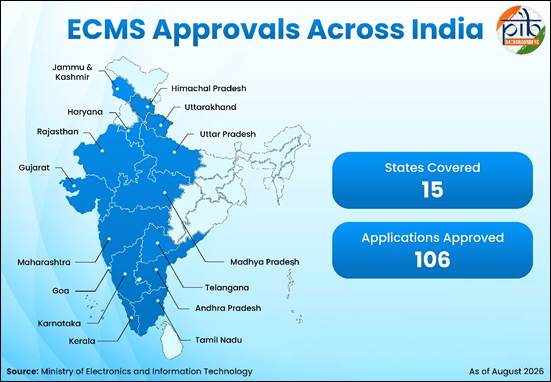
- As of August 2026, 106 projects have been approved across 15 States.
- These projects cover 30 electronic domain products and involve an approved investment of ₹69,548 crore.
- Production has already ongoing at 38 approved plants. Another 16 projects are at advanced stages of construction or machinery installation.
- The approved projects are expected to generate ₹ 5.34 lakh crore in production.
- They are also projected to create 74,628 direct jobs and 2.5 lakh indirect jobs.
- ECMS is strengthening domestic capacity across critical electronics components and materials. Production capacity now meets or exceeds domestic demand across several product categories.
Government Strategic Initiatives to Boost Electronics Manufacturing
- National Policy on Electronics 2019 (NPE 2019): Set the overarching objective of positioning India as a global hub for Electronics System Design and Manufacturing (ESDM). This includes developing core components and an enabling environment for globally competitive manufacturing.
- Production Linked Incentive Scheme (PLI) for Large Scale Electronics Manufacturing: Introduced performance-linked incentives of 4%–6% on incremental sales for eligible target segments. The focus is on scaling domestic electronics and mobile manufacturing.
- Scheme for Promotion of Manufacturing of Electronic Components and Semiconductors (SPECS) and Modified Electronics Manufacturing Clusters (EMC 2.0): SPECS provided a 25% capital-expenditure incentive for electronic components, semiconductor/display fabrication, ATMP (Assembly, Testing, Marking, and Packaging) units, specialised sub-assemblies and capital goods. EMC 2.0 supported world-class manufacturing infrastructure, common facilities and Plug-and-Play capacity.
- PLI for IT Hardware: Offers production-linked incentives to boost domestic manufacturing and attract investment. PLI 2.0 builds on this to strengthen the manufacturing ecosystem, cut import reliance, and position India as a trusted global supply-chain hub.
- Semicon India Programme: The ₹76,000-crore Semicon 1.0 programme created a broader semiconductor and display manufacturing ecosystem. It complements electronics manufacturing with support for fabs, packaging, testing, design and related capabilities. Semicon 2.0 was approved in July 2026 with a ₹1,27,500 crore outlay. It aims to scale India into a global semiconductor hub.
- Electronics Manufacturing Clusters (EMC) Scheme: This offers financial assistance of up to 50% of the project cost with a ceiling of ₹50 crore for every 100 acres of land for greenfield projects.
- Phased Manufacturing Programme (PMP): Establishes a structured, tariff-based approach to deepen domestic value addition in cellular mobile phones and their key sub-assemblies.
- Electronics Development Fund (EDF): Serves as a Fund of Funds investing in venture funds (Daughter Funds) to supply risk capital and promote market-driven innovation, product design, and startup growth in ESDM and IT.
Towards a Global Electronics Manufacturing Hub
The Electronics Components Manufacturing Scheme is helping translate India’s electronics manufacturing ambitions into investment, production and employment. As projects move from approvals to construction and commercial production, ECMS is broadening the country’s manufacturing base, deepening domestic value addition and strengthening integration with global value chains. With electronics exports already emerging as a major export category, India is targeting a $500 billion (₹47.75 lakh crore) domestic electronics manufacturing ecosystem and $150 billion (₹14.33 lakh crore) in electronics exports by 2030, reinforcing its ambition to become a globally competitive electronics manufacturing and export hub.
References
Ministry of Electronics and Information Technology:
PIB Backgrounders
Cabinet
Ministry of Commerce & Industry
Electronics Components Manufacturing Scheme
*****
PIB Research
(तथ्य सामग्री आईडी: 151016)
आगंतुक पटल : 114
Provide suggestions / comments