PIB Backgrounder
From Policy to Prosperity: GCCs Leading India’s Growth Journey
Posted On:
11 DEC 2025 10:41AM by PIB Delhi
Overview
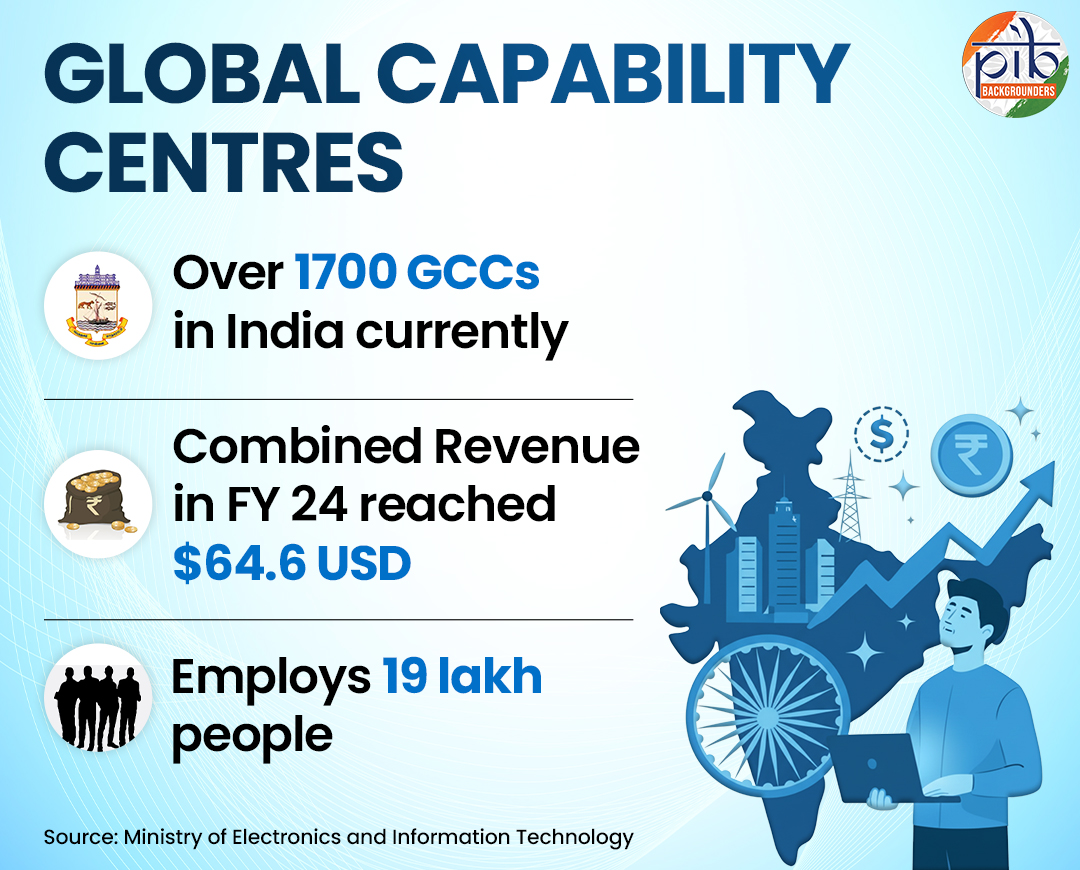
As talent meets technology, a new future for enterprise solutions is being shaped in India with over 1,700 Global Capability Centers (GCCs). These are the backbones of big companies, and they’ve come a long way. What started as a basic support desk has now evolved into an innovation powerhouse, driving research, design, and development. Global Capability Centres (GCCs) are offshore units set up by companies to deliver a range of services for their parent organisations. Functioning as integral parts of the global corporate structure, they provide specialised expertise in areas such as information technology, research and development, customer support, and other business operations. GCCs play a vital role in achieving cost efficiency, tapping into skilled talent pools, and fostering collaboration between parent firms and their international affiliates.
Many multinational companies in India have set up GCCs to handle verticals like business processes, IT services, R&D centres, innovation hubs, customer service centres, and other key functions. These GCCs have rapidly grown into strategic hubs for innovation and value creation. In just five years, their combined revenue has jumped from $40.4 billion in FY19 to $64.6 billion in FY24, growing at a healthy pace of 9.8% annually. Not limited to numbers, these GCCs now employ over 19 lakh people across the country, shaping the future of tech and business from right here in India. These centres drive innovation, digital transformation, and strategic operations for their parent organizations worldwide. The Government of India has played a pivotal role in nurturing this ecosystem through progressive policies, infrastructure development, and startup support, positioning India as a preferred destination for global enterprises.
India at the Heart of Global GCC Expansion
India has become a leading hub for Global Capability Centres (GCCs), with major clusters in Bengaluru, Hyderabad, Pune, Chennai, Mumbai, and the National Capital Region. The sector is projected to reach USD 105 billion by 2030, supported by nearly 2,400 centres employing over 2.8 million professionals.
- Expansion – Over 400 new GCCs and 1,100 units added in the past five years.
- Technology – GCCs centralising ecosystems in India, especially in aerospace, defence, and semiconductors.
- R&D Growth – Engineering research GCCs are growing 1.3 times faster than overall GCC setups.
- Talent – India contributes 28% of the global STEM workforce and 23% of global software engineering talent.
- Leadership – Global roles expected to rise from 6,500 to over 30,000 by 2030.
- Innovation – AI and ML adoption with centres of excellence strengthening India’s GCC landscape.
Government-Led Ecosystem: Enablers for GCC Growth in India
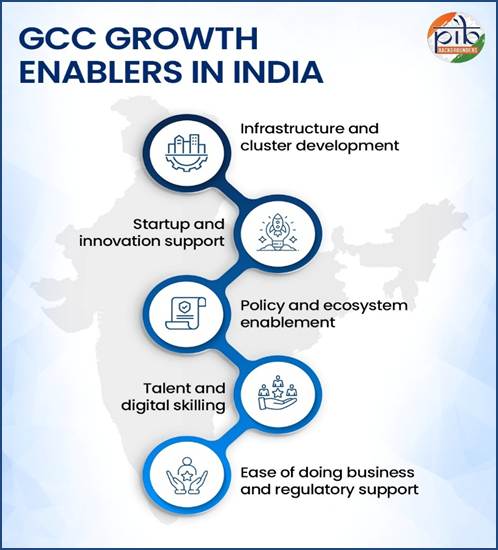
India’s rise as a global destination for GCCs is the result of a carefully crafted approach that spans infrastructure, innovation, talent development, and supportive policies. Government-led initiatives have created a strong foundation where international companies can grow, collaborate, and innovate with confidence. From nurturing startups to building a digitally skilled workforce, the environment is well-prepared for GCCs to thrive and lead transformative change.
|
INFRASTRUCTURE AND CLUSTER DEVELOPMENT
|
|
Modified Electronics Manufacturing Clusters (GENESIS)
|
- Launched by the Ministry of Electronics and Information Technology (MeitY), this scheme supports the creation of world-class infrastructure for electronics and IT industries.
|
- Offers Ready Built Factory (RBF) sheds and Plug-and-Play facilities, ideal for GCCs seeking rapid deployment and scalability.
|
- Encourages global manufacturers and their supply chains to set up operations in India.
|
|
STARTUP AND INNOVATION SUPPORT
|
|
GENESIS – Gen-Next Support for Innovative Startups
|
- A flagship initiative by MeitY with a budget of ₹490 crore, aimed at nurturing startups in Tier-II and Tier-III cities.
|
- Helps build a feeder ecosystem for GCCs by accelerating innovation and talent development.
|
- Encourages collaboration between startups and GCCs for co-creation and digital transformation.
|
|
POLICY AND ECOSYSTEM ENABLEMENT
|
|
Startup India and DPIIT Recognition
|
- India is now the third-largest startup ecosystem globally, with over 1.97 lakhs DPIIT-recognized startups.
|
- These startups contribute to the GCC ecosystem by offering cutting-edge solutions, AI/ML capabilities, and digital services.
|
- Government reforms and digital infrastructure have created a business-friendly environment for GCCs to thrive.
|
|
TALENT AND DIGITAL SKILLING
|
- Initiatives like Skill India, Digital India, and Future Skills Prime (by MeitY and NASSCOM) are equipping India’s workforce with next-gen digital skills.
|
- These programs ensure a steady pipeline of skilled professionals for GCCs in areas like cybersecurity, cloud computing, data analytics, and AI.
|
|
EASE OF DOING BUSINESS AND REGULATORY SUPPORT
|
- India’s consistent improvement in the Ease of Doing Business rankings, along with liberalized FDI policies, has made it easier for global firms to establish and expand GCCs.
|
- SEZ reforms, tax incentives, and single-window clearances further streamline operations.
|
The Economic Survey 2024–25, released by the Ministry of Finance, highlights that Global Capability Centres (GCCs) in India have moved beyond their traditional back-office roles to become strategic hubs for engineering R&D, particularly in aerospace, defence, semiconductors, and advanced manufacturing. GCCs are driving growth and innovation in the services sector, supported by India’s skilled workforce, ease of doing business reforms, and liberalized FDI policies. This transformation positions India as a global leader in digital and engineering innovation while strengthening its self-reliance in high-tech industries.
Conclusion:
With a thriving ecosystem driven by innovation, talent, and forward-looking policies, India has become a launchpad for global capabilities. As GCCs continue to evolve from support engines to strategic nerve centers, the country stands poised to shape the future of enterprise. The momentum is strong, the foundation is ready, and the world is watching India lead the way. The journey from service to strategy is not just underway, it’s accelerating.
References:
Ministry of Electronics & Information Technology (MEITY):
https://www.meity.gov.in/offerings/schemes-and-services/details/modified-electronics-manufacturing-clusters-emc-2-0-scheme-wNyEDOtQWa
https://www.pib.gov.in/PressReleasePage.aspx?PRID=1767604
https://sansad.in/getFile/loksabhaquestions/annex/185/AU2873_BLv260.pdf?source=pqals
Ministry of Commerce & Industry:
https://www.pib.gov.in/PressReleasePage.aspx?PRID=2135116#:~:text=The%20Department%20of%20Commerce%20notified%20reforms%20to,now%2010%20hectares%2C%20down%20from%2050%20hectares.
https://www.pib.gov.in/PressReleasePage.aspx?PRID=1756966
https://www.pib.gov.in/newsite/PrintRelease.aspx?relid=184513
https://www.pib.gov.in/PressReleasePage.aspx?PRID=2098452
Ministry of Skill Development and Entrepreneurship:
https://www.pib.gov.in/PressReleasePage.aspx?PRID=2100847
Economic Survey (2024-25):
https://www.indiabudget.gov.in/economicsurvey/doc/echapter.pdf
Indian Brand Equity Foundation (IBEF):
https://www.ibef.org/blogs/global-capability-centres-gccs-in-india
Click here to see pdf
***
PIB Research
(Release ID: 2202046)
Visitor Counter : 18716