PIB Backgrounder
From Classrooms to Creation Labs
Catalysing School-Level Innovations under NEP 2020
Posted On:
05 DEC 2025 11:10AM by PIB Delhi
Key Takeaways
- Atal Tinkering Labs (ATL) set up under the Government of India’s Atal Innovation Mission (AIM), are working to foster curiosity and innovation among students from grades 6 to 12 nationwide.
- As on October 2025, there are 10,000 Atal Tinkering Labs (ATLs) established in schools, engaging more than 1.1 crore students. In addition, 50,000 ATLs are in the process of roll-out for the period 2025-2026.
- As on October 2025, ATLs have led to the creation of more than 16 lakh innovation projects across the country.
Introduction
India’s education system is evolving rapidly under the present government's transformative initiatives, addressing the nation's diverse educational landscape and socio-economic disparities. Driven by the National Education Policy 2020’s (NEP 2020) focus on shifting away from rote learning to an enquiry-based education, curricular and policy level reforms have been brought in, and several initiatives have unfolded across the country that seek to foster and nurture a spirit of enquiry among students, and promote a culture of innovation on campuses.
In school education the unfolding transformation is visible in an average classroom where blackboards, textbooks, rote memorisation and the all-consuming efforts to top board-exams have been replaced by smart, digitally supported classrooms. AI-powered apps are now offering personalised help, students are creating climate-action projects using collaborative AR tools, and voice-based generative AI is helping read NCERT lessons aloud. These are some of the salient features of today's modern education system and it is happening in thousands of classrooms-where the NEP 2020 is replacing rote learning with analytical and play-based education.
National Education Policy 2020: Disseminating Knowledge via Creative Learning
India’s National Education Policy 2020 (NEP 2020), explicitly rejects rote memorisation as the default mode of learning. The document declares that the curriculum and pedagogy must shift towards developing critical thinking, creativity, scientific temper, communication, collaboration, problem-solving, and ethical values.
To bring out the creative potential of every learner and nurture future leaders, NEP 2020 institutionalises experiential and joyful pedagogies across all stages. In order to embed creativity in daily school life, the Ministry has replaced the 10+2 structure with a 5+3+3+4 design. Foundational years (ages 3-8) are 100% play-based; middle school mandates art-integrated and experiential learning; secondary students have been freed from rigid stream structures and must complete at least one vocational or innovation project every semester . Every textbook, every question paper and every classroom activity is now required to measure application and innovation, not mere recall. Board exams, governed by the new National Assessment Centre (PARAKH), can be taken twice a year.
Furthermore, digital integration has accelerated this evolution, with initiatives like PM e-VIDYA and DIKSHA providing unified access to online resources, virtual labs, and teacher training platforms, reaching over 25 crore school children and mitigating disruptions from global events like the COVID-19 pandemic. The Union Budget 2025-26 further bolsters these efforts with a 6.22% increase in education funding to ₹1,28,650 crore, of which ₹78,572crore dedicated to school education.
Apart from overall changes in curriculum brought in by the National Curriculum Framework for different stages of schooling, pedagogy that focuses on experiential learning and evaluation that reflects actual comprehension and assimilation, there are many special initiatives, schemes and programmes that are aimed at promoting innovation and critical thinking in schools.
Atal Innovation Mission (AIM)
Atal Innovation Mission (AIM) stands as one of the pivotal initiatives that has transformed education at the school level by facilitating creative stimulation in the young minds. The Atal Innovation Mission (AIM), launched in 2016 by NITI Aayog is Government of India’s flagship initiative to create and promote a culture of innovation and entrepreneurship across the country. Through various programmes and policies AIM fosters innovation in different sectors of the economy, providing stakeholders with platforms and collaboration opportunities with the objective of strengthening the innovation ecosystem in the country. AIM’s interventions cover schools, colleges, universities, research institutions, private and MSME sector. Some of the major programmes under AIM include Atal Tinkering Labs in schools – through these, AIM, is fostering the spirit of creativity and innovation at the school level; Atal Incubation Centres that are creating a world-class ecosystem for start-ups to flourish; Atal Community Innovation Centres that are encouraging the spirit of innovation with a focus on underserved/unserved regions of the country and Mentors of Change where skilled professionals provide pro-bono mentoring to young ATL innovators. The various parts of the AIM ecosystem are linked together and managed through the AIM Ecosystem Development Program (AEDP) Together these programmes aim to take students through the stages of Student Tinkers to Student Innovators to Student Entrepreneurs.
All Atal Innovation Mission initiatives are systematically tracked and managed in real time through advanced MIS (Management Information Systems) and interactive dashboards.
Atal Tinkering Labs (ATLs)
Atal Tinkering Labs (ATL) are dedicated makerspaces established in schools across India that aim to promote a culture of innovation and entrepreneurship, by fostering curiosity, creativity, imagination, and essential 21st-century skills, such as design mindset, computational thinking, adaptive learning, and physical computing. These labs provide students with hands-on access to tools for prototyping, including DIY electronic kits, 3D printers, sensors, robotics equipment, and mechanical tools, enabling them to tinker, experiment, and develop solutions to real-world problems. ATLs aim to ‘Cultivate one Million children in India as Neoteric Innovators’. Key activities include collaborative projects, and integration into school curricula to encourage STEM (Science, Technology, Engineering, and Mathematics) education and mentorship from over 6,200 Mentors of Change. Taking the tinkering idea a step ahead ATL has also launched the ATL Student Innovator Programme (SIP) where student innovators get the opportunity to develop their ideas with accredited business mentors from world class Atal Incubation Centres. Students also participate in special events like hackathons, ATL Marathons and Tinkerpreneurships. Prominent events under ATL include the annual ATL Marathon—a nationwide innovation challenge where students submit prototypes addressing themes like sustainability and healthcare.
Since their inception in 2016, over 10,000 ATLs have been established in schools nationwide, with a significant focus on reaching underserved regions, including aspirational districts and rural areas. The program has also expanded through partnerships, inspiring similar innovation ecosystems, while continuously upgrading lab equipment to include emerging technologies such as AI toolkits and IoT devices. As on November 2025, there are over 1.1. crore students actively engaged in ATLs spanning across 35 states and 722 districts across the country.
Additionally, the rollout of 50,000 Atal Tinkering Labs (ATLs) in government schools over the next five years starting 2025, is igniting innovation and scientific temper among youth.
The outcomes of ATL have been transformative. Students have developed prototypes addressing local issues, such as sustainable agriculture tools, health devices, and environmental solutions, resulting in numerous patents, startups, and global recognitions. Top performers from events like the ATL Marathon have secured internships, mentorships, and awards. These efforts have empowered marginalised students, boosted school performance in innovation metrics.

Atal Incubation Centres (AICs): Building India’s Startup Ecosystem
Atal Incubation Centres are world-class business incubators established at universities, institutions, and corporates to nurture innovative startups and ambitious entrepreneurs. AIM has operationalized 72 AICs nationwide, which provide startups with infrastructure, mentorship, seed funding, industry networks, lab facilities, and co-working spaces. These centres have incubated over 3,500 startups, generated more than 32,000 jobs, and supported over 1,000 women-led ventures across sectors like HealthTech, FinTech, EdTech, Space & Drone Tech, AR/VR, Food Processing, and Tourism.
Atal Community Innovation Centres (ACICs): Reaching Unserved & Underserved Regions
To bring technology-driven innovation to Tier-2/3 cities, aspirational districts, tribal, hilly, and rural areas, AIM is establishing Atal Community Innovation Centres (ACIC) through a unique co-funding model (up to ₹2.5 crore grant from AIM, matched or exceeded by partners). So far, 14 ACICs have been set up to democratize innovation opportunities in underserved parts of the country.
Atal New India Challenges (ANIC): Driving Product & Service Innovation of National Importance
The Atal New India Challenge is AIM’s flagship program to identify, fund, and mentor technology-based innovations that address critical sectoral and societal challenges. Selected startups at the prototype stage receive grant-in-aid of up to ₹1 crore along with comprehensive commercialisation support over 12–18 months. Phase 1 supported 53 startups, while Phase 2 has shortlisted 88 startups for funding and mentorship.
Mentor of Change Initiative: Building a Nationwide Mentorship Network
In order to power all its programs, AIM launched “Mentor India – The Mentors of Change,” one of the country’s largest mentor engagement campaigns. Over 6,200 mentors from industry, academia, NGOs, and the public-private ecosystem are currently registered, providing guidance, expertise, and partnerships to students and entrepreneurs across AIM initiatives.
The Atal Innovation Mission (AIM), therefore, stands as uniquely significant because it does not treat innovation as an isolated school activity or a one-time event; instead, it builds a seamless, end-to-end innovation continuum that begins at the school level and flows uninterrupted into higher education, research institutions, startups, and industry. Through Atal Tinkering Labs (ATLs), children from Class 6-12 are exposed early to hands-on problem-solving, design thinking, and emerging technologies, igniting curiosity and a maker mindset. This foundation is deliberately carried forward: the most promising ATL students can then be linked to Atal Incubation Centres (AICs) in universities and colleges, where they can prototype real products; the best university-level innovations receive scaling support through the same ecosystem via Atal New India Challenges, Community Innovation Centres, and industry partnerships. Equally important, innovations emerging from universities and research institutions are fed back into the school ecosystem through the Mentor of Change network and collaborative projects, ensuring that cutting-edge ideas inspire the next generation right from the grassroots. In short, AIM creates a living, interconnected innovation pipeline starting from school to higher education, entrepreneurship, and societal impact — so that curiosity sparked at the school level never remains a “sporadic science project” but grows into solutions that shape India’s future.
There are various other significant initiatives that transform the school level education from a strictly rote-learning pedagogy to creative and analysis-based learning. Some of these key initiatives include the following:
School Innovation Council (SIC)
The School Innovation Council (SIC) is a flagship initiative launched by the Ministry of Education’s Innovation Cell (MIC) in collaboration with the All India Council for Technical Education (AICTE) and the Central Board of Secondary Education (CBSE) on July 1, 2022. It serves as an umbrella program to foster innovation, ideation, creativity, design thinking, and entrepreneurship among school students and teachers, encouraging out-of-the-box thinking and hands-on innovation activities. SICs are established within schools as dedicated councils comprising a chairperson (typically the principal), convenor/activity coordinator, teacher representatives (including trained Innovation Ambassadors and a social media coordinator), expert representatives (such as entrepreneurs and industry professionals), and student representatives. Key activities outlined in the SIC Calendar 2024-2025 include leadership talks and panel discussions with innovators, field visits for problem identification, workshops on problem-solving methodologies, business model development, and Demo Days for showcasing prototypes and proof-of-concepts (POCs). Schools are encouraged to register on the official SIC portal to access resources, submit reports, and earn star ratings based on a five-star credit point system that ranks innovation achievements nationally.
Relevance and Expected Outcomes
SIC supports NEP 2020's focus on holistic, experiential, and vocational learning by fostering ideation and entrepreneurship. It prepares students for 2047 challenges like sustainability and tech disruption, bridging academia, industry, HEIs, and experts for real-world application beyond rote learning. This is particularly crucial in underserved regions, where SIC bootcamps and training programs build startup culture and STEM skills, aligning with national goals like Atmanirbhar Bharat (self-reliant India). It also enhances teacher capacity through programs like the School Innovation Ambassador Training Program (SIATP), ensuring sustainable implementation.
School Innovation Ambassador Training Program (SIATP)
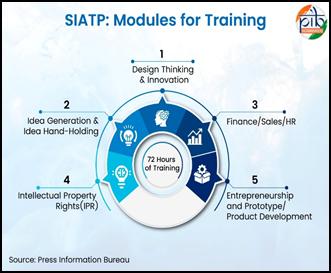
The School Innovation Ambassador Training Program (SIATP) is a comprehensive upskilling initiative launched by the Ministry of Education's Innovation Cell (MIC) in collaboration with AICTE, CBSE, and the Ministry of Education. Designed specifically for school teachers, it delivers 72 hours of intensive training across five modules covering design thinking, intellectual property rights (IPR), ideation, entrepreneurship, problem-solving methodologies, startup ecosystems, innovation management, and project handholding. The program transforms teachers into Innovation Ambassadors who can lead innovation activities in schools, mentor students on prototype development, and facilitate participation in national challenges.
Relevance and Expected Outcomes
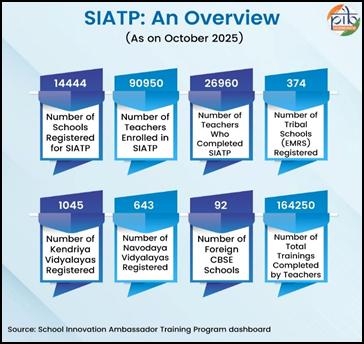
SIATP directly fulfils NEP 2020’s vision for continuous professional development by making innovation training mandatory for school leaders and educators. It fosters a culture of innovation at the grassroots, by equipping teachers with the skills to nurture creativity, critical thinking, and entrepreneurial mindsets among students. The program bridges the gap between policy and practice, helping schools shift from rote learning to experiential, project-based education. By training teachers as facilitators, SIATP supports the creation of School Innovation Councils (SICs) and integration with initiatives like Atal Tinkering Labs (ATLs)—building a scalable model for equitable access to innovation education, especially in government and rural schools.
Through SIATP, teachers have been certified as Innovation Ambassadors, now mentoring thousands of student-led projects—from ideation to prototyping and patent filing. These ambassadors lead Demo Days, hackathons, and innovation challenges at the school level, significantly boosting student participation in national programs such as the Smart India Hackathon and ATL Marathon.
INSPIRE Awards - MANAK
Innovation in Science Pursuit for Inspired Research (INSPIRE) scheme is one of the flagship programmes of Department of Science & Technology (DST), Government of India. The INSPIRE - MANAK (Million Minds Augmenting National Aspirations and Knowledge), being executed by DST,
works with the National Innovation Foundation (NIF) with the goal of working on one million original science ideas resolving science and societal problems.
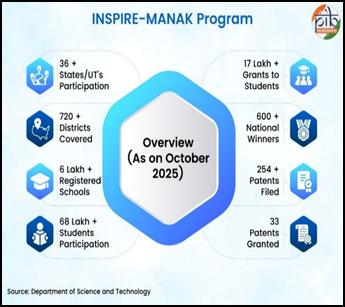
Schools conduct internal competitions and nominate up to 5 best ideas (maximum 2 from Classes 11-12, Science stream only) in any Indian language through the E-MIAS online portal following extensive awareness campaigns, regional workshops, and capacity building for district, state, and school functionaries across India.The program unfolds in four simple stages: first, 1 lakh ideas are shortlisted and awarded ₹10,000 scholarships through direct bank transfer; next, district-level exhibitions select the top 10,000 projects; then, state competitions choose 1,000 winners who receive expert mentorship to build working prototypes; finally, a grand national exhibition showcases all 1,000 innovations. Projects are evaluated for their novelty, social impact, environmental sustainability, user-friendliness, and technological merit. The top 60 innovations receive national awards, product development support from the National Innovation Foundation (NIF), and an opportunity to be showcased at the Annual Festival of Innovation and Entrepreneurship (FINE).
Relevance and Expected Outcomes
INSPIRE Awards - MANAK aligns seamlessly with the National Education Policy (NEP) 2020's emphasis on experiential learning, critical thinking, and integrating innovation into school curricula to nurture a problem-solving mindset. It promotes equity in STEM education, supporting Atmanirbhar Bharat by encouraging indigenous solutions to local issues, fostering entrepreneurship from an early age, and contributing to India's goal of becoming a global innovation hub by 2047. The scheme is spread across more than 36 states/UTs covering 720 (approximately) districts. Furthermore, it has recorded over 600 national winners with more than 6 lakh schools registered from across the country. Student participation has been over 68 lakh.
Hackathons and Marathons
Hackathons and innovation marathons have evolved from one-off events into powerful nationwide platforms that channel the raw curiosity of school students into focused, real-world problem-solving. These large-scale challenges act as vital connectors in the broader innovation journey, transforming classroom ideas into prototypes with national impact and creating clear pathways for young innovators to scale their solutions. Leading this movement are two flagship initiatives: the annual School Innovation Marathon and the Viksit Bharat Buildathon 2025.
School Innovation Marathon
The School Innovation Marathon, launched on July 29, 2024, is an annual initiative under the Atal Innovation Mission (AIM), NITI Aayog, in partnership with the Ministry of Education’s Innovation Cell (MIC), AICTE, and UNICEF YuWaah. Open to schools with or without Atal Tinkering Labs, it engages students in tackling real-world community challenges by developing innovative prototypes aligned with the Viksit Bharat 2047 vision.
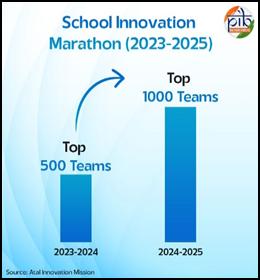
The marathon includes capacity-building workshops focused on design thinking, robotics, and intellectual property rights (IPR), equipping students with the skills to create impactful solutions. By encouraging hands-on learning and collaboration, the initiative nurtures creativity and technical expertise. This holistic approach not only enhances students’ innovation capabilities but also prepares them to address pressing societal needs with sustainable, scalable solutions.
The outcomes of the School Innovation Marathon are tangible and far-reaching, which recognises top-performing teams each year--1000 teams for the 2024-25 cycle and 500 for 2023-24. By nurturing future innovators, the program contributes to the long-term vision of Viksit Bharat by 2047.
Viksit Bharat Buildathon 2025
Viksit Bharat Buildathon 2025 is a nationwide school-level innovation hackathon organised by the Department of School Education & Literacy (DoSEL), Ministry of Education, in collaboration with Atal Innovation Mission (AIM), NITI Aayog, and All India Council for Technical Education (AICTE). It engages students from classes 6-12 in ideating and building prototypes based on four themes: Vocal for Local, Atmanirbhar Bharat, Swadeshi, and Samriddhi.
The event includes a synchronised live innovation session across schools, with submissions evaluated by experts. It was launched on September 23, 2025, while the registrations occurred via the portal https://vbb.mic.gov.in/.
Relevance and Outcome
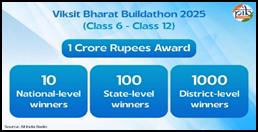
The program promotes self-reliance, sustainable growth, and creative thinking among young students to contribute to national development, aligning with Viksit Bharat 2047. It builds on the School Innovation Marathon 2024 and fosters grassroots innovation, positioning India as a global innovation hub.
The Buildathon culminates in January 2026 with results and felicitation of over 1,000 winners. It features an award pool of 1 crore rupees distributed among 10 national-level winners, 100 state-level winners, and 1,000 district-level winners[30]. It builds on the success of programmes, such as the Student Innovator Programme (SIP) and Student Entrepreneurship Programme (SEP), along with patents and startups from related initiatives.
Conclusion: Forging a Unified Educational Legacy for India's Tomorrow
India’s school education system is undergoing a profound transformation, driven by the National Education Policy (NEP) 2020. Innovative government initiatives like Viksit Bharat Buildathon, School Innovation Marathon, Atal Tinkering Labs, School Innovation Councils, SIATP, and INSPIRE Awards-MANAK, collectively shift from rote learning to experiential, skill-based education fostering critical thinking, AI readiness, entrepreneurship, and self-reliance. By integrating digital platforms, hands-on tinkering, teacher upskilling, and inclusive programs targeting underserved regions and girls, these efforts have engaged millions of students, produced lakhs of prototypes, patents, and startups. This has also driven tangible outcomes like record-breaking innovation events and universal foundational literacy goals. With increased funding and a commitment to 100% GER by 2030, India is decisively positioning its youth as global innovators, paving the way for Viksit Bharat by 2047.
References:
Press Information Bureau:
https://www.pib.gov.in/PressReleasePage.aspx?PRID=1838743
https://www.pib.gov.in/PressReleaseIframePage.aspx?PRID=2098805
https://www.pib.gov.in/PressReleasePage.aspx?PRID=2097864
https://www.pib.gov.in/PressReleasePage.aspx?PRID=2170192
https://www.pib.gov.in/FactsheetDetails.aspx?id=150345&NoteId=150345&ModuleId=16
https://www.pib.gov.in/PressReleseDetailm.aspx?PRID=2178518
https://www.pib.gov.in/PressReleasePage.aspx?PRID=2170192
https://www.pib.gov.in/PressReleseDetailm.aspx?PRID=2155388
https://www.pib.gov.in/PressReleasePage.aspx?PRID=2166700#:~:text=The%20Hon'ble%20Prime%20Minister,%2C%20Atal%20Innovation%20Mission%2C%20said
https://www.pib.gov.in/PressReleasePage.aspx?PRID=1847064#:~:text=School%20Innovation%20Council%20(SIC)%2C,of%20the%20best%20prototypes%20etc
https://www.pib.gov.in/Pressreleaseshare.aspx?PRID=1847064#:~:text=In%20order%20to%20strengthen%20the,Property%20Rights(IPR);%205.
https://static.pib.gov.in/WriteReadData/specificdocs/documents/2025/sep/doc2025928649601.pdf
https://www.pib.gov.in/PressReleasePage.aspx?PRID=1642049#:~:text=With%20emphasis%20on%20Early%20Childhood,HFW)%2C%20and%20Tribal%20Affairs
Doordarshan:
https://ddnews.gov.in/en/shaping-viksit-bharat-50000-atal-tinkering-labs-to-drive-innovation/
https://www.newsonair.gov.in/indias-largest-school-hackathon-viksit-bharat-buildathon-2025-begins-today/
Atal Innovation Mission:
https://aim.gov.in/pdf/Final-List-Top-1000-teams.pdf
https://www.aim.gov.in/pdf/Results-Top-500-Teams-ATL-Marathon-2023-24.pdf
https://aim.gov.in/atl.php
https://aim.gov.in/atl.php#:~:text=Impact%20created,Innovation%20Projects%20Created
https://atl.unisolve.org/#:~:text=Hear%20what%20our%20teacher%20and,for%20societal%20and%20humanitarian%20benefit%22
https://aim.gov.in/aim-ecosystem-development-program.php
https://aim.gov.in/overview.php
School Innovation Council:
https://sic.mic.gov.in/aboutus
https://sicmicstadiag.blob.core.windows.net/sicwebsite/static/downloads/SIC-Guidelines-2024.pdf
https://sia.mic.gov.in/
All India Council for Technical Education:
https://aicte.gov.in/downloads/initiatives/AICTE-VISION-MERGED.pdf
School Innovation Mission:
http://it.delhigovt.nic.in/writereaddata/Cir2024525900.pdf
Department of Science and Technology:
https://www.inspireawards-dst.gov.in/UserP/award.aspx
https://www.inspireawards-dst.gov.in/
Ministry of Education:
https://www.education.gov.in/sites/upload_files/mhrd/files/NEP_Final_English_0.pdf
https://www.education.gov.in/sites/upload_files/mhrd/files/nep/Background_Notes_Thematic_Sessions.pdf
https://www.education.gov.in/shikshakparv/docs/Examination_and_Assessment_Reforms.pdf
National Council for Educational Research and Training (NCERT):
https://www.ncert.nic.in/pdf/NCF_for_Foundational_Stage_20_October_2022.pdf
Click here to see PDF
RK
(Release ID: 2199237)
Visitor Counter : 7309