Posted On:
28 OCT 2026 11:15AM by PIB Delhi
|
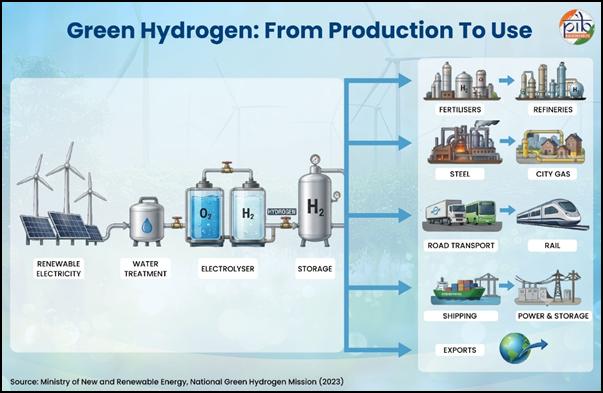
Green hydrogen is emerging as a pillar of India’s clean energy transition. It is produced by splitting water using renewable electricity. It can help reduce emissions in sectors such as fertiliser production, petroleum refining, iron and steel manufacturing, heavy-duty road transport and shipping. The National Green Hydrogen Mission (NGHM) supports domestic manufacturing, production, assured demand and credible certification. From green ammonia auctions to India’s first hydrogen train, early projects point to a promising path.
|
Why Green Hydrogen
Hydrogen is an energy carrier that stores energy and delivers it for varied uses. In a fuel cell, it reacts with oxygen to produce electricity, leaving only water and heat as by-products, and no polluting compounds or greenhouse gases. Although pure hydrogen is not found in large quantities in nature, it can be extracted from compounds such as water or natural gas. Its environmental impact therefore depends on how it is made. Conventional methods rely on fossil fuels and release carbon emissions.
Production using renewable electricity from solar and wind power can cut this footprint substantially. Hydrogen made by splitting water using renewable power is called green hydrogen. Unlike fossil-based routes, this process emits far less carbon. India’s abundant solar and wind resources make domestic production feasible. This diversifies the country’s energy sources and strengthens energy security. It also supports India’s goal of net-zero emissions by 2070.
Green hydrogen matters most in sectors where cutting emissions is difficult. Reasons include high-temperature heat needs, chemical processes and few alternatives to fossil fuels. These hard-to-abate sectors include fertiliser, petroleum refining, iron and steel, heavy-duty road transport and shipping. Fertiliser and refining plants already use hydrogen, so green hydrogen can replace the fossil-based supply. It can also support lower-emission steelmaking, selected transport uses and energy storage. It is especially useful where direct electrification is difficult or less practical.
For India, wider adoption could reduce dependence on imported fossil fuels. It would also lessen exposure to global fuel price swings. The sector could open opportunities in manufacturing, draw investment, create jobs and expand exports. Building capabilities across the value chain would strengthen domestic supply chains and spur industrial innovation. Green hydrogen can thus support self-reliance, sustainable industrial growth and a low-carbon future.
|
What Makes Hydrogen “Green”
Hydrogen releases no carbon dioxide when used, so its climate impact depends on how it is produced. In August 2023, the Ministry of New and Renewable Energy (MNRE) notified India’s Green Hydrogen Standard. Hydrogen qualifies as green if emissions do not exceed 2 kg of CO₂ equivalent per kg of hydrogen, on a well-to-gate basis, measured as a 12-month average. India thus became one of the first few countries to define green hydrogen formally.

|
|
Creative Minds, Catalyzing Science, Empowering Technologies
ESTIC-2026, the second edition of India’s Emerging Science, Technology and Innovation Conclave, is being held from 27–29 October 2026 at Bharat Mandapam, New Delhi. Organised by the Council of Scientific & Industrial Research (CSIR), the conclave follows the theme “Creative Minds, Catalyzing Science, Empowering Technologies.” It advances emerging frontiers in science and technology, including energy technologies such as Green Hydrogen Technology. Spanning 12 thematic areas, ESTIC-2026 features plenary sessions, technical discussions and exhibitions. The conclave also promotes strategic collaborations in support of India’s vision of Viksit Bharat 2047. Read More on Agenda: ESTIC 2026
|
How Is Green Hydrogen Produced?
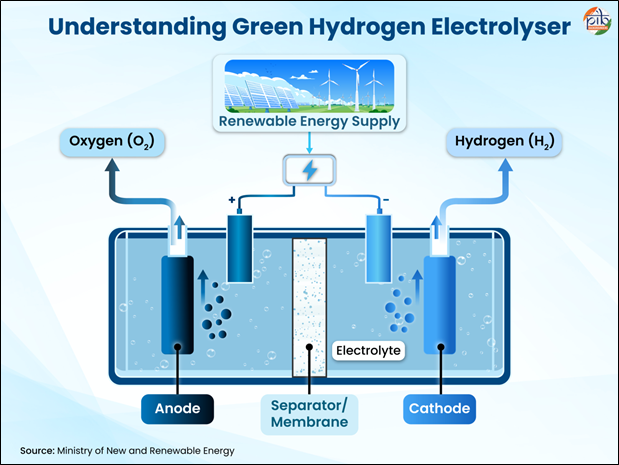
Green hydrogen is produced mainly through water (H₂O) electrolysis. Electrolysis uses electricity to split a compound into simpler substances. Here, renewable electricity splits water into hydrogen (H₂) and oxygen (O₂), with minimal emissions.
2H2O → 2H2 + O2
The key equipment is the electrolyser. It contains two electrodes, a cathode and an anode, connected to a power source. They operate within an electrolyte, which helps ions move through the cell. A diaphragm keeps the gases apart while allowing ions to pass. When current flows, hydrogen forms at the cathode and oxygen at the anode. The gases are collected separately for further usage. An electrolyser thus turns renewable electricity and water into a low-emission fuel for industry, transport and other uses.
|
Did You Know? Water is purified before electrolysis, because impurities can damage cells and shorten their life. According to MNRE, about nine litres of demineralised water is needed per kg of hydrogen. Afterwards, the hydrogen is dried and purified before compression. India’s Green Hydrogen Standard counts emissions from each of these steps.
|
Applications of Green Hydrogen
- Fertilisers: Ammonia, made from hydrogen and nitrogen, is the base for nitrogen fertilisers such as urea. Most of this hydrogen now comes from natural gas. Green hydrogen can replace it and yield green ammonia with far lower emissions.
- Petroleum refineries: Refineries use hydrogen to remove sulphur from petrol and diesel, so the fuels burn cleaner. They also use it to upgrade heavy oil into lighter fuels such as diesel, aviation turbine fuel and naphtha. These fuels serve road transport, aviation and industry. Most refinery hydrogen comes from fossil fuels, so a green supply can cut refining emissions.
- Steel: Conventional steelmaking uses coal to strip oxygen from iron ore, releasing carbon dioxide. In direct reduced iron routes, green hydrogen can do this job instead. The reduction stage then releases water vapour in place of carbon dioxide.
- City gas networks: Green hydrogen can be blended with natural gas in limited proportions, subject to safety standards and infrastructure compatibility. This allows existing gas networks to supply a hydrogen-natural gas blend to homes, businesses and industries. Such blending can reduce fossil fuel consumption and associated emissions while utilising existing distribution infrastructure.
- Road and rail transport: Fuel-cell vehicles convert hydrogen into electricity on board, which drives electric motors. Their only emission at the point of use is water vapour. This suits buses, trucks and trains that need long range and quick refuelling.
|
Did You Know?
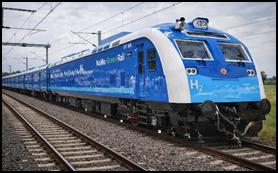
India’s first indigenous hydrogen-powered train was inaugurated on 17 July 2026 on the Jind–Sonipat section. The 10-car trainset can carry around 2,600 passengers. A facility at Jind stores nearly 3,000 kg of hydrogen. The train emits only water vapour and heat. Click to Read More
|
- Shipping: Green hydrogen can be converted into green ammonia and green methanol, which can fuel ships. These can replace conventional marine fuels on long voyages. Adoption depends on engine compatibility, safety requirements and port infrastructure.
- Exports: India can supply green hydrogen and derivatives, such as green ammonia and green methanol, to countries seeking low-emission fuels. India’s renewable energy resources can support this supply. Exports can open industrial opportunities and strengthen India’s position in low-emission fuels. Click to Read: India’s Green Hydrogen Production Potential
|
Bringing Cohesion in Government Approach
The Government has adopted an integrated strategy to increase the adoption of Green hydrogen across the sector. It coordinates with Central and State Ministries, Departments, agencies and institutions to drive adoption. Each Ministry has a defined role. For example, Ministry of Petroleum and Natural Gas promotes use in refineries and city gas distribution; Ministry of Chemicals and Fertilisers encourage indigenous green ammonia-based fertilisers; Ministry of Road Transport and Highways enable transport use through regulations, standards and codes; Ministry of Steel drives adoption in steelmaking; Ministry of External Affairs facilitates collaboration with global partners.
|
India’s Green Hydrogen Policy Architecture
NGHM: A mission for the whole ecosystem
MNRE is implementing the NGHM to make India a global hub for green hydrogen and its derivatives. The Union Cabinet approved the Mission in January 2023 with an outlay of Rs19,744 crore. It targets production capacity of at least 5 million metric tonnes (MMT) annually by 2030. With export demand, this could reach 10 MMT per year. The Mission has the following components.
SIGHT: Support on both sides of the market
The Strategic Interventions for Green Hydrogen Transition (SIGHT) Programme is a key NGHM component. Its outlay is Rs17,490 crore up to 2029–30. It offers incentives for two purposes: domestic electrolyser manufacturing and green hydrogen production. Together, they strengthen indigenous capability and speed up production.
|
Key Progress
- Incentives have been awarded to 15 companies for 3,000 MW per annum of electrolyser manufacturing capacity. This reduces dependence on imported supply chains.
- About 8,000 tonnes per annum of green hydrogen capacity had been commissioned by February 2026.
- Incentives have been awarded for 8,62,000 tonnes per annum of green hydrogen production capacity.
|
The NGHM supports pilots that replace fossil fuels and feedstocks in hard-to-abate sectors. These include steel, heavy-duty mobility and shipping. The pilots aim to identify technological, regulatory and infrastructure gaps. They will also test supply chains and technology integration. Their findings will guide commercial-scale deployment and the policy support needed. The Mission has earmarked Rs455 crore for low-carbon steel up to 2029–30. It has also earmarked Rs496 crore for mobility and Rs115 crore for shipping up to 2025–26.
|
Key Progress
- Five pilot projects have been sanctioned in the steel sector. Rs84 crore is sanctioned for testing 100% hydrogen injection.
- Twelve projects will deploy 70 hydrogen vehicles: 27 buses and 43 trucks. These include fuel cell electric vehicles (FCEVs) and hydrogen internal combustion engine (H₂-ICE) vehicles.
- The projects also cover 16 hydrogen refuelling stations across 21 routes. Financial assistance of Rs41.58 crore has been released.
- V.O. Chidambaranar Port Authority has awarded a pilot project to develop bunkering and refuelling facilities for green methanol. The project costs Rs 38.12 crore, including an MNRE grant of Rs 35 crore.
|
Green Hydrogen Hubs and Hydrogen Valley Innovation Clusters (HVIC)
Hydrogen is difficult to transport. To address this, the Mission promotes hubs and HVICs. This cluster approach brings production, consumption and infrastructure together. It improves project viability and enables economies of scale. Projects in designated hubs can also access Central and State scheme benefits. The Mission has an outlay of Rs 400 crore up to 2025–26 for hubs and related projects. These initiatives aim to attract green investment and accelerate innovation.
|
Key Progress
- MNRE has recognised Deendayal Port (Kandla, Gujarat), V.O. Chidambaranar Port (Tuticorin, Tamil Nadu) and Paradip Port (Odisha) as hubs.
- An indigenously built 1 MW green hydrogen plant was commissioned at Kandla Port in July 2025.
- Four HVICs have been awarded: Jodhpur, Odisha, Pune and Kerala.
|
Enabling Policy Framework
The Mission follows a whole-of-government approach to make green hydrogen affordable. MNRE coordinates with Central and State departments on benefits and project facilitation. Key measures include waiving interstate transmission charges and facilitating renewable energy banking. They also include time-bound Open Access and grid connectivity. The Government will coordinate planning for renewable capacity, transmission, banking and storage. Solar Parks, Manufacturing Zones and Special Economic Zones (SEZs) may be extended to hydrogen facilities. The Mission will also explore international green finance, green bonds and innovative financing.
|
Key Progress
- Green hydrogen and green ammonia plants commissioned by 31 December 2030 are exempt from Inter-State Transmission System (ISTS) charges for 25 years. ISTS are fees for moving power across state boundaries. The waiver lowers electricity costs.
- The Green Energy Corridor Scheme supports lines and substations that carry renewable power to the grid. A national transmission plan improves links between generation and consumption centres. Click to Read More
- Duty benefits under Section 26 of the Special Economic Zones Act, 2005, have been extended to eligible units installing and operating renewable energy equipment exclusively for captive consumption. This can reduce the cost of setting up renewable energy facilities within SEZs to meet their own electricity requirements.
- Standalone plants producing green hydrogen or green ammonia through water electrolysis using renewable energy have been exempted from prior Environmental Clearance under the Environment Impact Assessment Notification, 2006. This can simplify the approval process for eligible projects.
- Renewable energy plants located within a Special Economic Zone (SEZ) or Export Oriented Unit (EOU) are exempt from the Approved List of Models and Manufacturers (ALMM) and Revised List of Models and Manufacturers (RLMM) requirements when supplying electricity exclusively to green hydrogen production plants or their derivatives. This provides eligible projects greater flexibility in sourcing renewable energy equipment, subject to the applicable exemption conditions.
- The Green Hydrogen and Green Ammonia Policy provides for Open Access within 15 days and banking of surplus renewable electricity for up to 30 days, subject to applicable provisions. Open Access allows producers to procure renewable electricity from sources other than their local distribution company. Banking allows surplus electricity to be stored as a credit and used later, subject to applicable regulations.
|
Regulations and Standards
The Mission is building regulations and standards aligned with industry needs. The aim is to enable sector growth and harmonise with international norms.
|
Key Progress
- India’s Green Hydrogen Standard has been notified. It sets a ceiling of 2 kg CO₂ equivalent per kg of hydrogen, well-to-gate, averaged over a 12-month period. This created a common benchmark.
- Scheme guidelines have been issued to fund testing facilities, infrastructure and institutional support for standards.
- Standards for green ammonia and green methanol have been notified. They set emission thresholds and eligibility conditions, supporting production and trade.
- MNRE launched the Green Hydrogen Certification Scheme of India in April 2025. The Bureau of Energy Efficiency (BEE) accredits agencies for monitoring, verification and certification.
- A dedicated portal went live in June 2026 for transparent certification and compliance. Credible certification will help Indian producers compete with confidence globally.
|
The Mission supports research and development (R&D) to make green hydrogen more affordable, efficient, safe and reliable. The Strategic Hydrogen Innovation Partnership (SHIP) is a public-private framework, with a dedicated R&D fund from industry and Government. Scheme guidelines for R&D were notified in March 2024, with an outlay of Rs 400 crore. As of June 2026, an initial R&D roadmap worth Rs 113 crore is supporting approved projects across hydrogen production, storage, and safety technologies.
A coordinated skill development initiative is under way. The Mission aims to generate over 6 lakh jobs across the value chain by 2030. So far, 8,149 candidates have been trained and 7,248 certified in hydrogen-related qualifications across 14 States and Union Territories. Training spans renewable power for electrolysers, electrolysis, storage, transport, safety standards and end use such as steel, mobility and refining. For innovation, Rs 100 crore has been allocated to start-ups working on green hydrogen technologies. The first nine start-ups have been approved, with total funding of Rs22 crore.
International Cooperation
The Mission promotes partnerships to develop technology, mobilise investment, build export markets and align standards.
|
Key Progress
- MNRE, directly or through the National Institute of Solar Energy, has signed MoUs, Letters of Intent or Joint Declarations of Intent. The partners are Australia, Finland, France, Germany, Saudi Arabia, the UAE and Uzbekistan.
- An MoU on renewable energy has been signed with the Netherlands.
- An India–US Hydrogen Task Force has been formed under the Strategic Clean Energy Partnership.
- Green hydrogen is a focus area of the India–US New and Emerging Renewable Energy Technology Action Platform (RETAP).
|
Six States have notified dedicated green hydrogen policies, complementing the National Green Hydrogen Mission. Gujarat, Andhra Pradesh, Maharashtra, Uttar Pradesh, Rajasthan and West Bengal are the States with notified dedicated policies.
Four more States are finalising their dedicated green hydrogen policies. Haryana, Punjab, Bihar and Keralam are working on the draft policies.
Seven States have integrated hydrogen into their existing industrial and renewable energy policy frameworks. These include Himachal Pradesh, Madhya Pradesh, Odisha, Telangana and Chhattisgarh.
The Road Ahead
The National Green Hydrogen Mission marks an important step towards building a cleaner, more self-reliant and globally competitive energy economy. By 2030, India aims to develop 5 million metric tonnes (MMT) of annual green hydrogen production capacity. This transition can reduce dependence on imported fossil fuels and strengthen the country’s long-term energy security. The Mission is expected to reduce cumulative fossil fuel imports by approximately Rs1 lakh crore by 2030.
Beyond energy security, the Mission seeks to create new opportunities for industrial growth, investment and employment. It is expected to mobilise over Rs8 lakh crore in investments and generate more than 6 lakh jobs across manufacturing, infrastructure, research and project development. The production and use of the targeted green hydrogen quantum could also help avert nearly 50 MMT of carbon dioxide emissions annually. Through these efforts, the Government aims to accelerate industrial decarbonisation, strengthen domestic manufacturing and position India as a global hub for green hydrogen production, use and exports. This will contribute to India’s broader vision of Viksit Bharat by 2047 and its commitment to achieving net-zero emissions by 2070.
References
Cabinet
Ministry of New and Renewable Energy (MNRE)
Ministry of Chemicals and Fertilisers
Ministry of Ports, Shipping and Waterways
Ministry of Railways
Ministry of Power
Ministry of Petroleum and Natural Gas (HPCL)
Ministry of Science and Technology (CSIR)
Parliament of India
Press Information Bureau (PIB)
Other sources
Click here to see pdf
PIB Research